 intriguing japanese-brazilian artist




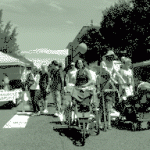
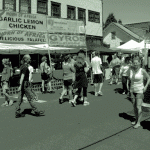

[North Portland, Oregon, USA; July 2011: a neighborhood over-run/gentrified]
I recall having to run for my connection to Miami because AA had trouble
getting the jet way to work. Didn’t head into the city to see the print
exhibit as the bus connections took too long and I was hesitant to leave
my bags with the storage operation in the airport (no lockers.) Grenada
Customs scrutinised my passport photo (I guess I have lost some weight)
but recognizing my haircut after I removed my 12hr cap seemed to clinch
it. Gave me 90 days no problem and were surprised I was going to be
staying on Petite Martinique for so long. Expensive cab ride from
airport ($20US I think) to Lazy Lagoon (where I had a reservation for
about $47US) but the bar was very loud and I was very tired so we went
over to the Tropicana Hotel where I was sure the girl said $35US but
later once the taxi had left, claimed the rate was $75US. I tried to get
it down to at least $50US to no avail. That _could be the actual rate as
the room was air conditioned and had a private balcony overlooking the
Carnage (natural harbour) but had seen better days. Made some good
recordings of some sort of cicadas and rain squalls through the night.
Had some fry chicken, rice, vegetables and beer from the adjoining
eatery. Watched the tourism TV channel in my room. Slept a little then
scrambled to get a morning taxi to the ferry dock. Very windy and
difficult to walk on board the Osprey. Some good pics of dramatic mist
rising from pockets of forest along the shore. Into Carriacou and PM
where E Clement from Palm Beach Restaurant came to meet me and take me
to my apartment. (a negotiated $400US/mo) A steep climb up the hill past
many goats and sheep. His web site implies that the apts are right on
the beach, but this was fine, a nicely equipped place with satellite TV
and with a great view across to Petite St Vincent, Carriacou and Union
Islands.
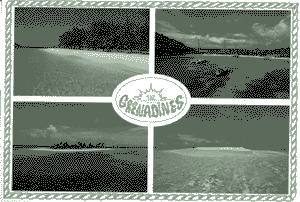
PM time line (from public school building):
1700s – Europeans settled on the island 1795 – Julien Fedoris Rebellion.
A Petite Martiniqian, Joachim Philip fought along side Fedon. 03-03-1795
– Joachim Philip led an attack on the Britisn settlement in Charlotte
Town (Gouyave) GND. 1850s – Church and School were established on the
island. 1897 – Father Joseph Aquart arrived on the island. 101 – A new
school building was completed. 1937 to the present – School building was
completed. 1941 – Alfred Hyacinth Roberts was appointed Principal of
this School. The first Petite Martiniquian to achieve such position.
1944 – The Old RC Church was destroyed. 1947 – The present RC Church
building was completed. 1953 – A Petite Martiniquian, the Hon Eva
Sylvester was elected to the Legislative Council. The first Grenadian
female to have achieved such position. 1955 – Hurrican Janet claimed the
lives of two Petite Martiniquians. 1961 – A serious drought affected the
island. 1970 – The first Post Office was opened 1972 – Michael Caesar
appointed a senator. The first Petite Martiniquian to achieve such. 1982
– Electricity was brought to the island. 1995 – The present post office
was completed. 1996 – A police station was established upstairs the
health centre. 1997 – Great controversy over the building of an American
sponsored Coast Guard Base. 1997 – The present police station completed.
1996 – Ministry of Carriacou and Petite Martinique Affairs, Petite
Martinique office opened. (compiled by Dwight Logan)
I feel asleep in the sun out in front of my place overlooking the
beautiful caribbean blue waters with a big glass of cold rum punch,
listening to a radio programme from SVG (St Vincent and the Grenadines.)
When I awoke, my earphones and the cord holding my sunglasses were
missing! I finally spotted them way over in the undergrowth — I can
only assume that the goats, who occasionally make their way up here to
eat the longer grass, from the house below, must have yanked them off! A
couple of days ago I sadly lost my nice gold Revo sunglasses in the
beach surf. I can usually wear them in shallow water with the cord
attached, but a big wave snuck up behind me and dragged them out to sea
— I still go back and scan the shoreline for whatever might remain of
them. That little stretch of beach has quite strong surf as I’m amazed
by how much sand, coral, conch shells and big stones has been
redistributed from one day to the next. You can hear — I made some
recordings — the round stones tumbling back into the water with each
receding wave. The mosquitos are very small and silent and seemingly
undeterred by deet — only a stiff breeze (plenty of that right now) or
electric fan keep them at bay. One night I grew tired of the fan-noise,
turned it off, and awoke the next morning with many itchy welts. I’ve
now also rigged up my mosquito net which seems to help.But if I continue
to get badly bitten I’ll have to consider getting off the island and see
if that helps. Apparently there is a small boat, Mystic, primarily for
school and mail, that goes to Carriacou at 7:30 am and returns in the
afternoon, so I may make that trip in any event, and see what options
are available there. I had previously made some accommodation inquiries
online and so have those contacts. PSV is a privately owned island that
I could also visit — I think this is where the smuggling activity
happens, as well as being an celebrity resort (Mic Jagger and others
whose names I’m not likely to recognize) E Clement (a common name on PM — I wonder if N, and I are related (?)scottish boat builder heritage.
Anyway, E is expecting some of his 10 siblings, wife and children for
christmas, and wanted to have a big screen tv for them, which he
‘ordered’ from PSV — but the coast guard caught and seized the boat
last night, along with the big TV! While I understand that Grenada duty
is not paid in these operations, I’d guess that duty and taxes must be
being paid somewhere, because I’m pretty sure these TVs aren’t
manufactured on PSV.but somehow there are some great savings to be
had…Fancy liquors seem pretty cheap and a big draw for the yachties
who come ashore. Despite the names of places here, no one except the
French yachties speaks the language or patois anymore. Other islands,
Petite Dominique, Moupin, Union, and the Tobago Keys can be reached from here for a price.
Yesterday (Sun Dec 13) the freighter MV Gemstar, left for its annual
passenger (party passage — think gigantic pounding speakers that you
can feel in your chest, in an otherwise empty metal cargo vessel ) trip
to St Vincent for only $40EC. I stepped aboard, looked around and took
some pictures and later made a little film of the ship leaving the dock
— a scruffy Caribbean Santa tended to the lines and waved from the
galley as the ship made its boozy passage on quite choppy seas. It was a
tempting offer but I’m sure I couldn’t have dealt with that much
‘volume’ overnight and then have to contend with a new reportedly
somewhat dangerous SV port in the early a.m. Made a good recording of a
big flock of birds with other intermittent sounds in a tree in front of
Melodies’ beachfront guesthouse at dusk — thinking I might do this on a
regular basis… The wind presents big difficulties, but I may try using
one of my mesh shirts to baffle more of the noise. Heard again that the
duty-free days may be coming to an end… an unpopular VAT tax and there
may be shortages in the shops — so I stocked-up on white rum and fruit
juice! Mailed more postcards, along with a matchbox to Ruud (a
Netherlands mail-artist) — forgot to watch if the stamps were actually
applied to the cards and matchbox… hope they are honest. Maybe I’ll
check on the matchbox today… just to give them a discrete idea of my
concern. Big, bright white yacht sliding past — apparently there are
many more and even bigger ones yet to come — February and January being
the most popular and driest months.
tyranny refuses you any societal existence… one by one everyone and
every institution turns against you
bought some “brail” nuts from an itinerant vendor down by the dock…
they had to boiled for 20 minutes… they’d be pretty good if they were
roasted instead (same deal with peanuts probably)… they taste vaguely
like brazil nuts, but a smaller rounded shape and are apparently from
the breadfruit tree — which I hope to find here as well
“I DON’T COUNT”
1 2 3 4 5 6 7 8 9 10 (transliterate the sounds of numbers one through
10)
example:
won you free your jive sex heaven hates mine then
enter to win; center two sin: all entries published (lulu, scribd, — be
sure to include your name/info with all posts to lists/bcc:
bbrace@eskimo.com.. best gets a limited Global Islands Project coin
edition: printed card with 6 (lowest common denomination) coins from the
last six islands visited!
Watched two turtles being butchered yesterday on the pier– one green
turtle and a hawksbill, while searching for a motorboat ride ($20EC) to
Carriacou. (Planned to attend a “phrang” event held the weekend before
Xmas but by the time we got there and then took a minibus into town,
there was only an hour or so before the big Osprey ferry did its usual
run back to PM. ($30EC) Felt badly for these ancient creatures,
upside-down on land with their throats slashed. Last week I spotted a
small ‘land turtle’ crawling along the road and took his picture which
only alerted the neighbourhood children to his presence. I fear he ended
up in someone’s cooking pot.Sounds as if there is harvesting limitation
however — probably during breeding-season.
Bought some colourful sweet potatoes and passionfruit, which I don’t
think I’ve ever tried. A lot of seeds to try and eliminate for very
little, slightly tart juice.

The sweet potatoes were very good — even cold they are tasty and sweet
with some salt. E got his smuggled big_screen TV after all, but he
thinks he may have to pay duty which will more than double the price.
His sister arrives tomorrow and presumably will be pleased to see big_TV
programs. I said I wasn’t particularly interested i n Direct-TV service
($20/mo) but E gave it to me until there were other guests./The good
news is that the boat’s owner didn’ t lose his boat and but lost the
goods from Grenada. He owns the biggest grocery store in town so we’ll
see how that all plays out…
I caught a tiny yellowfin fish off the pier this morning with my new
miniature rod — it doesn’t seem to cast though… which seems strange.
I will have him for breakfast tomorrow. Saw a barracuda in the water but
not sure if my rod could bring him in or not… Last week I bought a
spotted red fish called Hine — would like to catch one of those as it
was very tasty. Only the locals are permitted to take fish with spears.
Bought some lentils. white and red beans, popcorn, vegetable oil, tiny
yellow mild peppers which I eat raw, dried cocoanut for my curry rice
and three brown eggs — I have one with grated cheese on toast for
breakfast on my eating days. There’s a lady up the road who does a
little BBQ on Saturdays but so far that’s been a non-eating day
unfortunately.
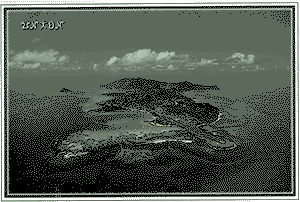
The neighboring outlying islands — PSV and Union actually seem to be
moving in closer.
Well, I finally remembered that the semi-circular bar has to go back
from the reel in order to cast. So that went pretty well this morning
except that the line got all snarled and I didn’t catch anything. Or, as
the fishermen, who seem surprised to see me there on the pier, say, “are
you holding anything?” Cecilia, who owns/owned a guesthouse way up on an impossible/near vertical incline, was on the pier selling salt-ham
sandwiches ($5EC) and apple-juice. She asked me if I wanted to ‘leave’
here — finally realized that she was saying ‘live here.’ I’ll have to
go and visit what’s left of her PM museum.
New guests next-door: not sure where they’re from, maybe the UK. What a
ruckus! For hours they loudly argued about having to climb this hill to
the Palm Beach apartments and whether they should stay. (Plus they run
their TV with the DirectTV box,’all night/day long. I’m left with one
horrid HBO-family channel. ) The website _is misleading, I too thought
the apartments were apart of the restaurant-complex on the beach. But
no, it’s not an insignificant climb up here; but the view of the water
is great and I’m getting used to it. And the goats merely stare at me
now rather than attempting to run… as far as their tethers permit.
There are blue-uniformed female workers who travel to PSV on a boat in
the morning and return at dusk as I’m recording the birds. They don’t
look very happy. There’s some chance that I could get a ride over there,
but would be restricted as to where I could go. There are prerequisite
‘rich & famous security issues’
PM apparently has one of the highest personal incomes in the Caribbean.
Don’t really see it, unless it’s the smuggling and maybe fish sales..
There are five guesthouses on the island.. There was a Christmas
‘serande’ last night that I had expressed an interest in but I guess
they saw that I was sleeping — I asked to be awakened next time.
Finally fixed my fishing rod — all the line was wrapped-up in the gear
complex somehow. Wound some of the untangled line back on the reel.
Should be good to go tomorrow morning. Also have a short ‘mooching rig’
set-up with ‘plastic pumpkin power slugs .” If I manage to catch a nice
fish I will share it with visitors (from a MN dairy-farm, on the lam for
several years) down below at the Millennium Guest house (next door to
the Matthew’s grocery shop.)
almost caught a fish this morning from the fuel dock — they don’t allow
fishing because I guess that dissuades the yachts from coming in; but I
was there at dawn before they were open. Getting better with the rod and
reel — it doesn’t really work all that well, but it was only$9 or so
from Big Five sporting goods in Portland. I’ll try for some fish again
tomorrow. Curiously I couldn’t find any nutmeg in town, despite this
being the Spice Islands. Apparently it’s good i rum punch. Had some BBQ
chicken from Mammy up the road last night. Pretty good. There were a
lot of people milling about, probably spilled-over from the ‘serenading’
that I could occasionally hear… a fiddle, guitar, something
percussive… all out of tune. Apparently you can join in and go house
to house; hopefully that might be possible at some point. Some drunken
local youths were slaughtering and butchering a cow and a pig on the
pier — it’s the Xmas season.
This little 20-yr old Sharp PDA is working pretty well, aside from
phreaking-out and opening all applications in quick succession when
plugged-i to 220V power. I usually just write names of things and ideas
for the GIP books in my Moleskin book because I typically can’t read my
ow writing and it’s too much trouble to transcribe it all. I should be
able to download this txt file to my computer at home.
Big Christmas “White Dance” at the RC public school. Typically loud for
the Caribbean but only went fro 10pm to 5am, only that long because the
band was late arriving. I went down to look around while they were
testing the sound system and realized it was going to be way too loud
for me. But noticed some interesting wall-paintings of Grenada political
personages and an outline of PM history which I photographed this
morning while on my way to buy some more sweet potatoes (black vine)
$5EC/lb (this time.) Still no White Jack overproof rum (140) at
Matthew’s store (or anywhere else), he offered something that no one was
willing to pronounce more than twice, “Jack-and-I” (?) in unmarked plain
bottles for $25EC which I purchased. No fish, not even a bite, this
morning. E told me I should use bait (instead of a lure, but that always
seems like cheating somehow) — apparently there are nighttime snails
that can be used, I may relent. There is some latent hostility towards
visitors which of course surfaces after imbibing… one silly f*ckers
got all upset because I didn’t want to help him carry his trash along
the beach this morning while I was o my way to fish. Another drunkard
decided to berate me for not wanting to talk with him while on my way
home. People here have that irritating
Not only can I not detect the tourist-promotional fragrance of nutmeg
and other spices in the air. there is none to be had in any of the
stores!
Caught one tiny fish this morning which I’ll use for bait, and one big
fish snapped my fishing line, taking my brass lure, swivel and sinker as
well!
Missed an outdoor karokee event last night : that,s what happens when
you go to bed too early. Should be some sort of musical Christmas day
celebration this afternoon at one at the “fisheries building.” >>
nothing there most of the day except recorded pop/reggae, but tagged
along with a Christmas “serenade band” that visited peoples’ houses in
exchange for libation. Pretty cool tradition: fiddle, guitars, drum,
rythum blocks, gourd and tincan shakers. Was called a “stupid white
f*cker… and what are you doing here…” yes, and merry christmas to
you too. There is hostility toward “foreigners” but then, unless you’re
a direct descendant of the Awark or Carib Indians, then you “don’t
belong here” either. Most islanders are quite polite but it’s a veiled
British kind of response that’s difficult to read. The usual reply,
which I heard in Belize and Nicaraugua too, is “ok” or “alright” as if
you had asked “how are you?” It may be more frustrating attempting to
understand someone is likely speaking patois English rather than an
entirely different language…not too many phrasebooks for this.
Strangely enough, Cousin N (and I) are likely related to Scottish
shipbuilding forbears of one of the oldest families (Clement) on the
island! Took a picture of Clement tombstones on my morning walk today.
Some mornings it’s a near-humourous cacophony from several households’
very loud stereos all playing at once, along with all the goats braying
(?)
There may be some maritime tradition about discharging last year’s
flares… anyway. that’s what’s been happening here the last two days…
hard to imagine that they’d be very useful in locating a v vessel in
distress as they veer way beyond, although impressively high, the
ignition point.
Never had so much trouble with mosquitos… I’m wearing $5 worth of DEET
but they still find some unprotected patch. Another red flare! Hear some
singing down below. Three more! If I lived here it would have to be way
up on the hillside but that’s a strenuous climb! Wonder why so few of
the rooftops are painted white or jus t left plain galvanized steel…
most are blue, red, or green. Some more music from further up on the
hill… must figure out how to get up there with out getting too
scratched-up. Can’t be more than two or three households and microwave
tower…Two more flares.
XXXXXXXXXXXXXXXXXXXXXX
The imagery in the 12hr project can be seen to poetically emulate the
blank, indifference typical of conceptual art and its documentation.
Yet. at the same time it’s clearly a dangerous affront to the conducive
elite and corrupt Artworld — there’s no other explanation for its
exclusion from their increasingly exclusive institutional discourse. The
12hr project has achieved its own orbit and raison d’etre. Perhaps this
is intimidating or alienating but what other recourse/discourse can it
expect? Well, at least some marginal acknowledgement and some financial
support! But no, after 30 years, there’s nothing but refusal and
indifference… the project has returned and enhanced this response; I’m
seriously, repeatedly and deliberately threatened afterall. Eventually I
will return fire and achieve maximum damage as per the Western maxim;
why not, it would be a very responsible response. Maybe I suspected all
along that my work would continue to be denied and so developed this
possibly corrosive aesthetic to shelter my poetry. It could be
rationalized safely in this manner but deep down it’s really much more
pristine and positive and curiously sheltered. You may notice a rhythmic
reoccurrence of sorted subject matters while the incidental lyrical
shots sketch a story-line that very few follow. Your history-tale is
just a big pack of lies after all. Snoop Dog cartoons. Slow rap. No
deal. Literally tens of thousands of people all over the world follow
this project now but sadly very very few decide to pay for this artwork.
There’s institutional-art which pays someone else and the rest which
pays nothing. Eliminating the art-institutions can only help alleviate
this absurd corrupt complicity. Meanwhile the art-acolytes grin and
incredulously, are seemingly grateful for the rare dribble of
chump-change in return for their insipid obeisance and betrayal. There’s
no middle ground here, you need to step way back from the table and
fight the architects of this dismal atrocity. Burn these
upper-middleclass social clubs masquerading as art-galleries/schools,
below the ground but not before nailing the administrators to the walls.
Record their screams and the sounds of ecstatic, licking flames as
glorious anthems to a restored, honest purpose. Rebuild from these newly
freed grassroots… The 12hr project has a Zen-like approach to
depicting an essentially non-existent present. The posted, internet
scans are close approximations of the printed photographs (whose
exhibition/printed-publication will likely continue to be denied as
well): they serve as FPOs (a production printing term meaning For
Position Only.) It’s serial, ostensibly populist nature (initially as
ISBN-books and faxes), denies exclusive Artworld nonsensical-hierarchies
and adapts seamlessly with Internet listservs, newsgroups, ftp-sites and
their mirrors, mailing-lists, and later, blogs and social-media. The
“twelveth hour” of impending destruction is ever-present and
simultaneously non-existent. There’s just a rarefied, residual,
reconstituted, uniquely-mediated poetic identity remaining…
But because the project demands some continuous, though slight effort
from recipients, it’s presumably discarded only because it’s not
conveniently, submissively packaged as rapid, received ‘critical’
inside-fodder-dissemination for the Artworld acolytes. Well,Yes , I
insist that you at least begin to understand the work before you open
your mouths and develop your hideous institutional ‘careers.’
Somali pirates of the Caribbean. I really wasn’t sure if it was a cop or
a just-released prisoner who accosted me outside the police-station this
morning: he was wearing a Grenada do-rag and tank-top and shorts, and
said something-something-island? I stood my ground and said “excuse me” and made him come to me. Drunken locals, beer bottle-in-hand, wander-into the precinct to shoot the breeze, but “foreigners” are treated
somewhat differently. I plan o becoming increasingly discourteous as my
departure date arrives. Wouldn’t mind visiting Union island and taking a
tour of the Tobago Keys, but moving around these parts is expensive. The
helicopter is in the air. But here’s the thing, I usually have similar
feelings on every island to some degree. I have this 10-10 flexible,
exponential axiom: if it takes 10 days to be acknowledged, then it’ll
likely take 10 years to be accepted, so this is likely a 20 year island.
Yet I suspect that I’m drawn to islands to in some way determine why I’m
routinely excluded, or why societies are apparently always based on
exclusionary principles. This is institutional logic, where the
overarching pseudo-precept preempts everything else that even dares to
attempt self-definition. I’m not the least bit surprised or alarmed by
~terrorism,~ just another name for ~freedom fighters~ what the hey….
displace, essentially-prolong and hopefully disrupt more of the same
privileged pointlessness. If there’s actually a God, beside deserving a
swift kick in the ass, his name should be Oblivion — unfortunately He’s
really not around any time soon. Listened to an Irish pastor (who’s
lived in Kenya) preach about the Potato-famine without once implicating
the government-of-the-day for needlessly causing its citizens to
starve-to-death. Why does corruption continue to usurp commonsense?
Had a big brown with speckles fish, interested in my lure, had to drag
it by him several times before he snapped at it. Must review my
fish-hook tying technique… have now lost all my lures! And as this is
a community of fishermen, who don’t tease the fish… there won’t be any
available here. as E said, fishermen use what they know works – bait –
Now he wants to charge me extra for electricity because I apparently run
the fan a lot. It’s necessary to keep the mosquitos at bay. The
Caribbean is starting to feel more and more like a rip-off for this
little fish. The goats are usually tethered from front ankle to stake
driven in the ground. Inevitably, they wind the cord around and around
the stake until they’re on very short tether. The herd from the house
just below, is sometimes stacked-out but today they were everywhere…
down by the school and the harbour and up above the house here. Maybe
they need to be tied-in-place once in a while so they (or their owners)
know where home-is. They’re horizontal irises make them seem
otherworldly, but always skittish and agile. Hope to include little
posterized folios of their heads for the GIP book.
Batteries are always an issue… I suspect it has something to do with
the 220V power-supply. My rechargeable AA cells which I use for my SW
radio no longer seem to enough of a charge to power the radio — same
story for the gumstick batteries for the Minidisc recorders…. despite
manufacturers claims of no-memory effect, the retention capability just
dwindles to nothing. Fortunately, the add-on AA battery pack which I
load with lithium cells helps-out. The battery-problem used to be worse
with the Fuji camera (I’d have to carry a few sets of AA’s with me
everyday); this new Nikon Coolpix runs a very long time on 2 AA
lithiums.
They somehow blow conch shells to announce the selling of fish on the
pier. Only Jack fish (mackerel I think: not so tasty) yesterday, so I
passed but E presented me with one this morning probably to appease this
rent/power increase. Even deep-fried, these fish are mealy… I may just
go or threaten to go, to Union Island… but that would cost a couple of
hundred.
Surprising how often guesthouse owners will tell you that it’s quite
safe and unnecessary to lock windows and doors… but, when _they leave
for the day, you always hear the locks.
BB’s travel-tips: apply your DEET (I use Ben’s 100%) _after your
sunscreen… also provides an especially curious sheen to your skin.
Purchase an extended-shank bicycle lock to secure common wardrobe closet
doors. I also travel with a heavy cable and Brinks key-lock for securing
either a bicycle or room. Third-world locks are not reliable and
key-copies circulate, especially on islands, despite there being an
apparent absence of locksmiths (?) Usually the locks are pretty-much
insignificant anyway as other points of entry are facile. Freaky! Only
because the prospect of recovering a PP/greencard is hellish within the
visa constraints.
I use a large Otter-box with miniature padlock, in combination sometimes
with a Pack-safe cable-mesh enclosure locked to something substantial to
secure passport and cash and electronics.
Copy of passport/greencard online and on mp3 players.
Never tell anyone the exact day of your departure as this when robberies
are most likely to occur — when you don’t have time to report the
incident.
Bring a short extension cord, multi-tap receptor, lightbulb socket
adaptor, sink sealer, rubber doorstops, duct tape, and laundry line.
You,ll use at least one of these everytime!
Tourist offices are often a good source for free postcards — a
significant savings if you send many.

New Years Day
After much stress and anxiety I decided to leave the “bug house” on PM.
Also picked-up a nasty centipede bite below my right eye and on my ear.
Happened at night while asleep under my mosquito net. I awoke to see my
swollen face in the morning, never saw the long black bugs with many
ridges that routinely invades the house. E told me they didn’t bite. At
first I thought it was a rash of mosquito bites and although opinion
seems divided, E thought it was a centipede (there’s a local name for
them which I forget.) Looks infected and swollen; applied Neosporone and
cleaned with rubbing alcohol. Hired a speedboat to take me to Union
Island (100EC – a little expensive I think) Went to the medical clinic
where they gave a free shot of hydracorasone. May go back again to have
them reexamine. Also will try the pharmacy for some penicillin ointment.
Staying at an apartment in Big Sand. (1100 EC per month plus power – I
overpaid $440US, which I’ll have subtracted from the power bill or next
month’s rent. This is very different island, with a different accent and
more relaxed attitude, popular with many visiting yachties. About 5000
people – more than 5 times PM population. Feels very peaceful with big
green waves crashing on the beach. Not so many mosquitos and the
apartment has window screens but I,ve setup my net this morning after
spotting a couple of bites from last night.
Sandflies here in the morning too. Picked up many new welts while
chatting with the Rasta who lives across the way. He says that I can go
to St Vincent and then to Beguia by ferry and that his sister has a
guesthouse in SV which apparently has the largest botanical garden in
the western hemisphere, which I’d sure to visit. Bequia is a whaling
community. We talked about snow and other natural disasters.’There is a
volcano in SV that is set to go. He recommended the movie 2012. Pretty
much everyone here on this street seems to be related. A neighbour’s dog
took one of my shoes from the porch, but I found it. Walked into Aston
then back over to Clifton where I got some Fucidin H antibiotic from the
pharmacy for my inflamed facial centipede bite. The pharmacist said if
this doesn’t work I’ll to take an oral antibiotic.
I’m looking forward to my eating-day tomorrow. I cooked some rice and
beans with lentils and carried back some curry, hot sauce, box of
matches, tiny green peppers like I had in PM, tin of cocoanut milk,
sardines, three tomatoes. postcards, and a sitting shelf figurine made
in Haiti for V. I.ll probably spend much of the sitting in the sun and
drinking overproof PM rum, on the private pier out behind the apt.
Post office was closed today for inventory but while in Clifton I heard
the sound the sound of a conch shell being blown and knew there were
fresh fish being sold, Bought a nice yellow fin tuna (4 lbs @ 8EC per)
Carried it home and cleaned it on the beach then fried it on the propane
stove in my apt, I broke my fasting rule but only meant to have a small
sample taste, Oh, is it ever good! Still plenty left for a few more
meals. The dog who stole my shoe has become more friendly after
watching me with the fish, Put a few scraps of my fish on hooks dangling
from the pier. A lot of wave action and rocks but there were little
green and yellow striped fish nibbling at the bait so maybe some bigger
ones will show-up.
Union Island History (from a sign on the island):
The first European settlers to arrive on Union Island were Frenchmen.
Jean Augler and Antoine Regaud, who settled here as early at 1763 with
350 slaves. Twenty years later, following the Treaty of Versaillies in
1783, Union Island like the other Grenadines Islands was placed under
the control of England, with Samuel Span and his family becoming the
first owner of the island. To this day there remains a reminder of this
family, in the form of a family cemetery in Ashton. In 1850 the Spans
sold Union Island to Major Collins from St Vincent. He in turn leased
the island to a Scotsman, Charles Mulzac in 1863. The lease was 150
pounds per annum. Along with some of the other Grenadines, Union Island
produced an exceptionally fine strain of cotton, known as
“Marie-Galante.” On his father’s death in 1893, Charles Mulzac’s son
Richard took over the lease of Union Island. His tenure was short. In
1898 a hurricane, coupled with a poor cotton harvest, forced him to sell
his interest in Union Island to a Vincentian, Mr Richard. Twelve years
later in 1910 the British Crown bought the island in what was known as
“the Union Island settlement scheme.” They parceled out 2 acre and 4
acre plots for the local population at favourable credit rates. In 1969
colonial states yielded to “Associated statehood” and ten years later in
1979, St Vincent and the Grenadines became a sovereign independent
nation within the British Commonwealth.
Getting a little annoyed having to leap off the road every time a car
races past.
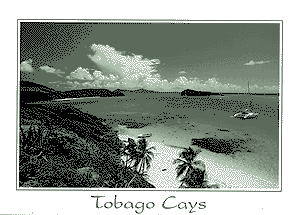
Went to the Tobago Cayes Marine Park office and Tourist Bureau and
picked up a big pile of brochures about SVG and conservation efforts, as
well as a weekly copy of the Vincentian newspaper (1EC) Headline for Dec
31 reads: “Eight Murders remain Unsolved.” Also some old copies of
Caribbean Compass monthly boating tabloid – very interesting to read
(boaters are being attacked and robbed at various Caribbean night
moorages) and reminded me to look around for Latitude 41 when I get
home, although maybe I should resubscribe to Freshwater News too.
Now the bottom of my right eye is red, don’t know whether some
antibiotic ointment travelled there or whether it’s an eyelash or
something wedged in.
Also had a look at the fancy yacht complex and airport runway next door.
Told Hazel, who runs a clothing shop next to the Clifton Beach
restaurant, that I had paid too much in rent (44EC or 76EC if you use
the 2.67 bankrate — I’ll be paying in EC next month) and that Y(?) her
sister (who runs the hotel I think and my apartment, that the excess
could be applied to my electricity bill. All the dogs are excited about
something outside but it’s usually very peaceful out here. And even i
town while you occasionally hear loud music, it’s nothing like the loud
cacophonies of PM.
Went into town this morning after a big breakfast of more tuna,
cocoanut-curry rice, and red and black-eyed peas with lentils along a
good wallop of hot sauce (sometimes I guess that peppery foods repel
mosquitos…], to mail postcards. ($1EC) While waiting for the TC
Marine Park office to open I purchased an expensive small glass of fruit
punch ($10EC) Apparently I can catch a ride with the park rangers if I
come to the office at 8 am tomorrow morning. There are fairly cool
T-shirts for sale down by the wharf, various colour combinations with
two sayings: Sail Fast/Live Slow or Sail More/Work Less — rather pricey
@45EC but if I get a free ride tomorrow I’ll get one. Likely blue on
orange. Not wanting to waste the 25 minute walk back home (although I
have found a dirt road shortcut), I purchased three boxes of juice (two
pineapple and one fruit punch) @ $9EC — much more expensive here than
PM, which implies that they really are avoiding taxes/duty or something.
This is very obvious with liquor prices. Also spotted a guy wearing a
Scaramouche crew T-shirt and asked about the traditional sailing
excursions to Maureaux, and I forget where else (200EC including lunch
for the day.) Saw a brief spiel about the ship on the TV tourist channel
but looking at it in the harbour from a difference she didn’t really
look all that special, assuming that I was looking at the correct boat,
she was flying a Canadian flag off the stern. The owner was sitting
astride a motorcycle next to the crew member and finally piped up to say
that they may or may not depart Thurs, Fri or Sat. Captain Yannis
cruises is another cheaper possibility but it’s just a big fiberglass
multihull. I’ll start with the rangers tomorrow. There’s a ship’s
chandlery shop in Clifton which I somehow associate with the owner on
motorcycle, that sells even more expensive and foreign groceries —
frequented by yachties in the morning for coffee and croissants; on
parle francais. Maybe one day. Very breezy this morning out on my
essentially private pier; big rolling green breakers. .. The dogs are
pretty bored (they like to chase the horny rooster that I hear every
morning), but they sit together and stare wistfully down the beach,
occasionally going for a brief dip in the sea. The old billy-goat is
tethered in the middle of the yard and will be under the picnic bench by
midday. I am beginning to discern the differences between goats and
sheep, at first I thought they were all goats on PM until Pam (along
with her partner Bill, originally from Minnesota then living in Be…for
five years until they were deported, informed me that there were sheep i
the mix. They look very similar, the goats a little more sinister.
The only edible tropical orchid, Vanilla planifolia (also known as
fragrans), which was originally cultivated around the Vera Cruz area of
Mexico, produces 99 percent of the world’s vanilla. Another genus,
Vanilla tahitensis, cultivated in Tahiti, produces beans with a stronger
aroma but weaker flavour. Vanilla pompona or Antilles Vanilla is
cultivated in the West Indies. Only saffron and cardamom are more
expensive spices than vanilla — the world’s most labour intensive crop.
Vanilla orchids are now grown in many tropical climates with
three-quarters of the world’s supply coming from Madagasgar. Because of
demand and expense, 97% of vanilla used is synthetic.
Well, I’m no longer interested in a Tobago Cayes T-shirt! The Marine
Park office repeatedly lied about the ride over with the rangers being
free. Turns out they want a “tip.” At first 80EC then finally 50EC and
they lied about taking me to a few islands and swimming with the
turtles. I just got dumped off on an island with rich tourists from
neighboring yachts willing to pay $120EC for a lobster dinner. Was
interesting to listen to the stoned ‘cooks’ carry-on amongst themselves
while playing dominos. I guess I was expecting a more pristine
environment, less trash, and something more than a yachters’ picnic
site. The water’s a nice colour. The ride was ridiculously ‘bumpy’,
slamming repeatedly down from wavecrests, really poor boat handling —
they probably wonder why their boat takes on so much water. Saw the
Cap’n Yannis catamaran over there and am no longer interested in that
dreadful tour either. I’ll just take it easy tomorrow, maybe visit the
fort in the morning or the next day. The parrot fish are brilliantly
coloured and have beak-like mouths; you can hear them too, They scrape
algae from the reef and pulverize the coral with their powerful jaws.
What they don’t need as nutrients passes through them as sand — an
adult parrot fish cam create a ton of sand every year.
Visited the fort today; quite a climb to see a pretty unremarkable
remains of a 16th C French fort. Why do we seemingly cherish contiguous
oppressive military refuse? Nice view though, I can now identify all the
islands within sight.
Basin Pond: (another sign)
This pond is part of the most extensive complex of 18th Century ruins on
Union Island. It was built between 1750 & 1763 by Jean Augler, one of
the island’s first French settlers. Basin, the largest of the island’s
ponds, stored and provided water for plantation slaves. It was entirely
paved with local stone, and cemented with heated coral and conch shell.
After emancipation in 1834, Basin Pond continued to be a main source of
water for local people. Up until the 1950s it was still used for washing
and watering animals.
Went down the road (none are named in these parts) to Gordon’s Bar and
Grill (there is no grill). actually a pretty spiffy green and yellow
place on a nice sandy beach with additional little cabanas and music by
Sam (who I’ve met but not heard yet) on Sundays. Other than that it
seems pretty much deserted, so I practised my snorkeling and made some
movies with my tiny, underwater ankle-cam, and collected dozens of
intriguing coral bits which I photographed back at the apartment. This
imagery may be intercut with the ankle-cam films and possibly outlined
and used as folios for my GIP book.
Then I went into Clifton to pick-up some more free postcards from the TC
Marine Park office — they visibly stiffened as I came in the door ;)
Was also looking to buy another fish and possibly record the conchshell
or pan music (Saturday’s probably a better bet for that), but instead,
made some fairly good, surreptitious recordings of domino games: lots of
slamming, shuffling and swearing in some patois I only partially
understand. No fish though, so instead I bought some bacon ($13EC, from
Wisconsin and frozen probably many years ago) at a little shop that’s
quite close to where I live — along with a big bottle of Mauby
concentrate, and a jar of SVG peanuts ($9EC). Her prices might be a
little better than in town where the rich yachties shop. Cooking the
bacon drove the dogs wild — especially when I poured-out the bacon
grease into the sand.
So for breakfast (my major meal), I had a fried egg, cheese, tomato
(very good here), bacon toasted sandwich followed by fruit-punch, my
rice and beans/lentils with hot sauce, and a nice cold glass of Mauby.
Had a little nap, maybe too much food all of a sudden and the rain this
morning.. Very dry here year-round; all the islands are really quite
arid — cactii are common. Thought to try and get a postcard to William
and Pam, originally from Wisconsin (did I cover this already?) who are
staying at the Millennium Guesthouse on PM. Will try to visit St Vincent
this month but I’m a little nervous about possible immigration nonsense,
even though it’s the same country. Sky has now brightened-up, typical
tropical downpour.
“ginger ales are 10c a glass if you don’t like that, you can kiss my
hairy ass”
went into town this afternoon and did some more domino recording…
gradually I’m being acknowledged there, but buying a couple of guiness
stout ($6EC) when hardly anyone buys anything, probably helps…
wandered back home and thanked the pharmacist for her help… people
don’t recognize me easily when they see my haircut instead of the Tilley
hat… it does keep me cool and doesn’t blow off (interesting design
that flexes with the wind, but somewhat squeakily…)’but it may be too
‘dorky.’unless I can batter it up a little, Another person I passed on
the road was surprised that I didn’t recognize him from PM , but with or
without my hat I’m bound to be more identifiable than local folks. I’m
also wearing my red mesh tanktop today (and all this week) which may be
significant. I see red flags flying at houses and hear of socialist
tendencies.
Different newspaper this week: Searchlight — purchased from the
taxi/minibus “Messenger.” Headline for Friday January 8 reads: Storm in
Bike Crash (Prime Minister’s Son undergoes emergency surgery in
Barbados) Will mail this big pile of postcards today. No music at
Gordon’s last night. The barkeep was asleep in a lounge chair. No
customers. The big white place with columns next door (Big Sand Hotel)
doesn’t seem to have any guests either.
Mailed the cards after waiting 20 minutes for the postmistress who
finally called to say she was at the clinic… and someone who was there
all along sold me the stamps. I guess civil ‘servants are the same
everywhere. The pharmacist passed through and said hello. They were
selling those little silver fish with the big eyes again. All you can
really do with them is deep-fry them whole — not especially tasty. Took
some pictures of the con/hshell blower and fish transactions and bought
some lettuce. 8 small tomatoes and a papaya ($19EC); vinegar from
Lambi’s ($6EC — there’s laid-back and then there’s arrogant
indifference that’s becoming too apparent there) Then back home stopping
at “J’s” for 3 boxes of pineapple juice (just $7.50EC there; and 3 eggs.
My hat frightened the little girl there I think. Made a simple salad
which I’m eating now.
(sign in Ashton):
You are now in Ashton, the second major town on Union Island. Union
Island (13.7 sq mi) is located 44 miles south of mainland St Vincent, It
is the second largest and most southerly of the Grenadine islands. Mount
Tabor, its highest peak, rises to 1000 ft. The island’s population of
approximately 2000 people is concentrated within the 2 main towns,
Clifton and Ashton. Union Island Island was settled as early as 5400 BC
by tribes from South America. However the present population is a
mixture of African and European descendants. The French were the first
Europeans, arriving before 1763. They were followed by the British, to
whom the French ceded the island in 1763. Slavery was abolished in 1834.
Thereafter some residents continued to cultivate the land, growing
mainly corn and peas. Many however, beccame seafarers. Today this
tradion continues and is supported by the island’s fishing and tourism
industries. Do enjoy your stay on our beautiful and friendly island.
Radio reception is poor here, even with the amplified antennae, which
I’m beginning to wonder about… of course, on PM I was way up on a
steep hill. Trying to listen to Radio Paradise 820 AM from St. Lucia.
Took another shot out my front door toward B’s (cute girl from St Lucia
and her aged US husband). On PM the repeated shot was toward Union
Island. Did I mention that the papaya was very good? Saved the seeds in
order to try and propagate at home.
The icecube tray shattered into a dozen pieces as I tried to extract the
cubes. The PM place had much better culinary tools but E was the cook at
his restaurant. I’ll head down to the pier and work on the watercolors
shortly. There’s no plausible reception point for any of my artwork so
it’s really an ongoing process, much like my 12hr-project. I’m starting
to overpaint (usually not a good idea for watercolours) the work from
Nicaragua. Some look pretty good; I’ll just keep going as much out of
spite… Had some sardines in tomato sauce and fed the remainders to the
little dog next door — surprised to see that the aggressive dog made no
moves, as he did with the bacon-grease. A=mazed at the sound this made
across the concrete deck… I’ll try to record something like it… A
coupe passed-by accompanied by the dog-chorus… no response but I was
wearing a miniscule swimming outfit.
Made some films of my pocket-kite flying off the pier. Wandered down to
J’s for a couple of Guinness Foreign Extras and seeing as they were out
of peanuts, I settled for some junkfood: cheeseballs and Pringles. This
morning (breezy and overcast: rain seems more likely in the early a.m.)
I made some more cocoanut-curry rice, this time I used canned c-milk but
had to add a little water at the end. Took a couple more pinholes from
the pier and one of B’s house (more seagrape foliage in the foreground
than house) before the sandflies drove me inside. Will look for some
more salad ingredients today. >> sudden brief tropical downpours >> the
girl in the Let Me Go bar and shop told me that the rainy months are
September and October and that the community library might open at 3
p.m. >> small bag of green beans (to add to my tossed salad), giant
papaya, small different kind of cantaloupe, onion (which I,ll use in an
omelette tomorrow), and cucumber (that I sliced-up and made into a
separate salad) = $21EC Y came by in a shared taxi and the driver
offered me a free ride the rest of the way home but I thanked him and
said I liked the walk, even though the one section of dirt road turned
out to be quite muddy. Went out to the pier and started to work on the
watercolours but quickly turned very windy and the rain started-up
again. Photographed some hummingbirds but stayed inside mostly listening to Radio Barbados and reading tourist info on St Vincent. Y loaned me a book on early Union Is entrepreneurs (augustus king mitchell… by
Gloria Stewart Morgan) and newspaper clippings. Apparently the
courthouse and historical records were set afire by two men awaiting
trial in 1979 — a small park in Clinton is on the site. Adjacent to it
is a semi-circle of brightly-painted vegetable stands. I’ve been buying
my produce from an older stand farther down the road, thinking it might
be cheaper there. I was surprised to learn that even here where the soil
is good, all the produce is imported from SV! The economy has been
Westernized I guess, as people used to grow most of their food.
Am wondering if my facial bug bite, which is nearly all healed was
caused by a scorpion. There’s a huge brown bug with long antennae that
lives behind the kitchen splashboard. He ‘sings’ a cricket-like song; at
first I thought it coming from outside or perhaps some squeaking part of
the refrigerator. Very sad news about the earthquake in Haiti. Being
Black and French I doubt much aid will materialize from the West.
Tried to exchange some money ($1000 US) at the only bank (big
flat-screen TV playing CNN ‘news’ about Haiti); they wanted ID and
didn’t accept a copy of my passport. I’m concerned they may notice
(perhaps needlessly) the absence of SVG visa-stamp, so maybe I’ll do
this in SV. I should probably carry that much cash anyway in case
something goes wrong, as it always does. Having waited in line for 40
minutes, I took my time putting away my ID and then tossed their
calendar back in the pile; did a good eye-roll and left. Why ask for ID?
I’d save about $70 on a grand with the bank rate. Saw Sam walking with
some white girl, he called me by name before I remembered who he was —
but I’m probably more distinctive than most here. (There are some pretty
inventive DIY haircuts here and sometimes they acknowledge mine.) In
tourist literature they say the locals have a good memory for faces,
maybe it’s true.
Put out the laundry for Shirley to pick-up. Exchanged money with no
problems. Called the MV Barracuda but it’s in the shipyard ’til maybe
next week. Will try to visit SV then. Happened upon a brief Big Drum
performance by primary and secondary students, intended for US PBS
travel programme. Shot some films and stills with the little Nikon. The
dance was performed for rain and courtships. Interesting to see how
pleased the locals were – some older folks were dancing off to one
side… PBS was so focused on their commentator they missed it. Topped
up my cellphone at the LIME office in Clifton.and got a SVG phone
directory. Bought some bread from the central market $3EC and some more
pineapple juice, Sunset Rum (84.5% alcohol). and three more eggs from
J’s ($32.50 EC) Looking forward to shopping in Kingstown; should be
much cheaper, Hope to buy some bootleg CDs of tinpan music, a pair of
locally fashionable, shinney white sunglasses with black lenses,
groceries and rum. Sat out on the pier again and worked on the
watercolours this afternoon. Walked into Ashton by way of Baddu (much
shorter) and bought popcorn, salt-fish ($12EC/lb), and onions. Inquired
about the BBQ but it’s not happening this week. Soaked some of the fish
for an omelette in the morning. Will take a shower now and make the bed,
then read more about Union Is entrepreneurs.
Followed the road and the a ‘track’ along Richmond Bay past a couple of
houses’ and a gated passageway toward the higher Zephyr hills. Saw some
probably abandoned, ransacked guesthouses and another mini-fortress with no apparent entrance that is only identified on one map as a ‘ruin.’ Got
tried of avoiding being scratched, scraped, and stuck in the overgrown
bush (‘burn bush’ and cactii) so didn’t proceed any farther — not
likely too much to see as the power poles didn’t continue either.
Wandered back home for rum punch and watercolours. Took some hour-long pinhole photos of the sky initially (too cloudy to see the circling
stars; another night) and the fanciful architecture across the way.
Watched a few installments of ‘Cash Cab’ on TV last night – still an
intriguing programme. The Rasta brother was chanting and rattling
outside. New Moon. Will attempt to see Mt Olympus and maybe the Chatham Estate today (a non-eating day: some Spice Black tea (with lime) that I packed.)) Next year I’d like to visit Netherland’s ABC islands (Aruba,
Bonaire, Curacao.)
Belmont Salt Pond sign:
This wetland has provided Union Island with salt since the times of its
earliest ancestors. During the 1700s, its “white gold” was also shipped
off to Europe by French & British colonizers. The island’s climate is
perfect for saltmaking — low rainfall, a warm breeze and lots of
sunshine for evaporation. High temperatures concentrate the sea water in
the wetland, forming layers of salt on its surface. Salt is usually
harvested from March to the beginning of the rainy season. In a good
year, thousands of pounds may be collected by hand. The wetland is a
nursery for many young fish and other sea creatures. It also provides an
important habitat for local and migrating birds, including herons and
ducks. Please help us to keep this wetland clean, and maintain its
centuries-old tradition.
Another Rasta from the same building has a big Isuzu truck and I asked
him if he could bring me a case of Guiness sometime but he says it will
cost nearly $100EC for 24 including deposit, so that’s about $4EC each.
Not a big savings over buying one at a bar for $6EC. Somehow I managed
to walk to Chatham Bay. The maps suggest this is not possible. It’s not
even mentioned in any guide book, even the local ones, but it’s easily
the most stunning locale that I’ve seen thus far on the island!
Beautiful beach and water with only a few beach bars, half a dozen boats
anchored close to shore, pelicans, and very quiet. At the far end of the
beach there’s this totally unexpected, very fancy, open-air
bar/restaurant complex that’s more than a little incongruous with
swimming pool and white pleather sofas! Amazing! I might go there
tomorrow for a BBQ and hear Sam’s music but it’s a fair, hour’s trek
over there and I’d have to head home before it gets dark. I doubt the
so-called dollar buses (a charter trip is $20EC) go there, you’d need a
four-wheel drive to make it down the rutted steep decline. There’s a
short cut through the bush following a dry watershed, but it’s pretty
arduous – going up at least. Thankfully I had my walking stick. Noticed
another road that might go to Bloody Bay, but someone told me that it
was “bushed over,” and accessible only by boat. Also a “track” that
might go to Mt Olympus. The island is quite bristling with 12hr imagery.
I’ll keep taking them but will likely wait for a few years before
processing them. I’ve already scanned over ten year’s worth and many of
the prints have still not been scanned even once. I can insert new
imagery with the “+” designation. Delaying processing will only decrease
contrast which is what I’m after anyway. There are gravel makers here
too, like in Thailand.
(another sign): Union Island, like its neighboring islands throughout
the Caribbean, has seen a succession of inhabitants in pre-colonial
times. The earliest evidence came from petroglyphic drawings found in
these areas (Grenada, St Vincent and Canouan), which indicate that the
Ciboney people were here as early as 5400 BC. They used primeval boats
of raft kind and made progress gradually into the Caribbean from the
South American coast lands. Their out-at-sea canoes exceeded 20 metres
in length. It is only much later, in the centuries preceding the
Christian era that other migrating waves of Amerindians, Arawaks and
Caribs followed in the path of the Ciboney people. The Caribs and
Arawaks originally came from the Orinoco Basin and traveled as far north
as Puerto Rico.
This bought vegetables from CJ’s stand in the square. Better prices I
think: several small tomatoes, cucumber, papaya, grapefruit, for $15.
And more Sunset Rum ($28EC this time), peanut butter (Marouks from T&T: $10), and crackers ( Crix also from TriniD $3.50)
Sitting on the porch ledge and suddenly bitten by some sand flies just
as a sudden shower started. Didn’t last 60 seconds. Earlier I layed in
the sun and had a swim in the third little beach down from me, but
washed all my Deet off. Brought the air mattress down but gave-up trying
to inflate it by mouth. The gasoline vendor in Clifton has a compressor,
so I’ll have to bring it over sometime. Made some ankle-cam films
including one of a little yellow crab with delicate white pincers. Not
at all like the bigger, crusty dark crabs that you see on the shore
rocks. (Not sure the camera is capable of focusing that close.) If you
sit very still they will eventually emerge from their sand burrows. This
one could walk forwards as well as sideways.
Another onion, tomato. cheese omelette with salt-fish. A little tired
this morning, maybe it’s all the food. Making another …
Spent the day working on the watercolors; using both sides of the paper
so they’ll be 100 when I’m done. Will scan their current state when I
get home and post an album to my websites and facebook. “Waters.” Many
people at and just down the road a bit from Gordon’s — it being Sunday
night. Making another Big Sand recording and will see how close I can
get to Bloody Bay (site of master/slave massacre), this morning, once
the threat of rain diminishes. Should try and pick up some groceries too
although I have plenty of cooked rice and beans, a still a little salt
fish and cucumber salad to eat tomorrow.
OK, I walked around Mt Olympus the other way (counterclockwise). past
Bloody Bay and Chatham Bay — up quite high so could see the rain coming
in finely veiled curtains across the water and hillsides. Saw Sam making
his way back from the Chatham beach bars, guitar slung over shoulder —
apparently he played for some people aboard a big white catamaran last
night and then slept on the fancy sofas in the big Italian bar. Spotted
a big land tortoise and walked part way down a track that might go to
Rapid Point (Sam says it’s a deadend at a quarry, but then he’s never
heard of Bloody Bay), before it turned overgrown. Walked and walked and
walked through Ashton and way out to the western end of the island along
an excellent concrete road, financed by the good ol’ Canadian gov’t,
that just suddenly ends. No one seems to live alongside it for some
reason — it is pretty windy — and other than an ancient French
plantation-era, unused pond/reservoir and the rusted remains of some
sort of quarry machinery, there were no other structures to be seen. The
tourist map indicates a Miss Irene bay or beach and a Miss Irene point.
I’ll have to ask Y who she was/is. So, back through Ashton where I
bought popcorn, kidney beans, fruit puch in a box, 4 eggs (they’re a
dollar each!), and a box of matches = $20EC
The Barracouda, MV Rita, MV Gem Star, Bequia Express, Admiral, Geronimo and Glenconner are mostly family-owned ships. I had just read an article about the Barracouda mailboat and its continual, reliable service for 15 years with only two mishaps, so I was disappointed to hear last week
that she was in the shipyard. Hopefully I’ll be able to take the 5 hour
trip this Friday morning (6:30 a.m.) I may walk around Kingstown and the
botanical gardens for a few hours and then catch another ferry to Bequia
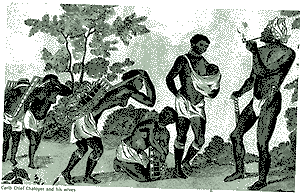
(Carib: land of clouds) and stay there overnight, catching an early
morning ferry back to Kingstown in time to pick-up some groceries and
board the Barracouda to Union Is. Did some more w/c on the beach but the
fine, sticky sand is getting in my paints, and all over me as well.
Interesting to see the wind create turbulence across the surface of my
w/c water, just as it does across the sea.
“Cuba before 1959 was a land of plenty for a handful of people and
misery and extreme indigence for the vast majority. It was a playground
of the mafia.” – Gonsalves SVG PM
Watched ‘Rabbit-proof Fence” on IFC again while waiting for the skies to
clear a little. Went downtown in search of Callicou soup but ended up in
this little unnamed place off the main street for a “little lunch”
(EC$10 + 3 for a 500ml Sprite), quite good chicken plus salad, rice.
Inadvertently followed the owner to the jetty where I bought some
“dolphin” (bares little resemblance to what it is commonly called) and
a slice of *Kingfish” for $10EC. Only tourists apparently like tuna
(that would be me); the dolphin is much sweeter — we’ll see on
Thursday. Headlines from the last copy of the Vincentian this week:
Another Pit Bull Attack! – big purple letters: “Mr Raleigh Baptiste, a
welder of Gibson Corner, was in his yard picking tangerines…” Met
‘Sam’ but apparently that’s the bartenders’ name, really it’s Raphael
Socony Holder, and his CD which he now reluctantly sold me for $10EC
(and refused my GIP card) is called “Which Part Don’t You Understand?” I
have no way of listening to it now and really have no idea if it’s good
or not. He seemed so flippant about the transaction that it could mean
one thing or another… earlier I went into the Kash & Karry mart to buy
buy some more funny peanuts in the glass bottle and the decided to buy a
Guiness Foreign Extra Stout — gosh, it’s really tasty… that got me
chattering to the proprietor about Island history which was going pretty
well despite his recalcitrant nature, until I fumbled the name of the
most western point… Janet? N? ok, yes it’s haha Irene Point. Bye-bye
and thanks.
Will try and see if the libraries are open today and maybe record the
children at the primary school.
Memorial Plaque:
This plaque is erected to the memory of all the African Slaves that died
in Union Island during the time of slavery. This Plaque is also
dedicated specially to the 53 slaves who died during a period of months
(Sept 1737 – July 1738) as a result of the harsh living conditions amd
cruel slave drivers of that time. This was the same period wehn cotton
production increased one hundred and twenty percent and the time of
major infrastructural development. May they rest in peace.
Ended-up walking around the second higher tier.. almost to the top of
the radio-tower hill but was dissuaded by dogs whose barking echoed
ominously off the rocky cliff-face. Walked through the village of
Donalson and then back into Clifton past the government school where I
heard singing at about 9 a.m., so will bring the recorder one morning at
that time. Bought some fish seasoning and I have one lime left for my
meal tomorrow. Thought about buying a bottle of red Ju-C (Big 16 (oz)),
primarily to photograph, but didn’t want to carry it about. Will check
on the Barracouda tomorrow, if it’s running I’ll be able to buy
groceries economically in Kingstown Saturday. Sat in a few places
downtown and watched the goings-on; read the entire issue of January’s
Caribbean vegetable sellers has a great singing voice, so I’ll try to
record her one day as well. Tried to have a little nap as I was up late
watching some movie (an old Jack Nicholson I think and a young girl
returning to a little-known family homestead and unearthing the
reluctant past…) on IFC. Wandered down the road to the Big Sand Hotel
with this Zaurus device to see if there was free WIFI signal — but no.
Now sitting on the pier writing this, the dogs come-up hoping to be
petted but I learned my lesson in Thailand.
“Let our quietly attentive staff infuse your sojourn with seamless grace
and gentle discretion…” Canouan resort
I like how the Vincentian newspaper runs their headlines into adjoining
pictures, sometimes reversing or coloring the type in the image-space.
This style wouldn’t have been feasible in the pre-digital typesetting
days, as too much of the picture would have been obscured. The roosters
are ‘crowing.’ The dolphin was good; the kingfish unremarkable.
Finished-off the cocoanut-curry rice, will make some more once I hear
about the Barracouda today. New maximum price for gasoline is
$11.15EC/gal.
Walked over to Chatham Bay and at first sat on the comfy lounge chairs
waiting for the bar to open but soon the rich chartered yachties
clambered to shore and started yacking about their annuities. I left and
went down the beach to what I’d hoped were less expensive
establishments, and who knows, maybe they really were… but the
Sunshine Bar wanted $8EC for a beer. I bought two and declined their
offer of a ^not too expensive fishcake lunch” and headed home early.
When an employee has to look at the owner to see what to charge for a
beer, (and the price on the menu, which I’d looked at earlier, is less)
you know something’s up. Sometime’s I can’t be bothered arguing about
prices and instead decide to never return. I suppose it’s difficult to
constantly encounter all that offshore ostentation and not want to reap
a little of that indifferent wealth, but it would be difficult to assume
that I belong in that privileged swagger. The one brown chicken has
returned for more popcorn. There really are some beautiful ones here,
but now she seems to be particularly interested in my toes. I called J’s
GH in Bequia and reserved a $100EC room in Bequia. I’m thinking I’ll do
this trip repeatedly; next week is some Blues Festival so maybe I’ll
reserve from there tomorrow.
Rolled my luggage up to the gardens in about 20 minutes. Botanical
Gardens (founded in 1765 by a British army medic, it’s the oldest in the
western hemisphere) : brandy & coconut water, cinnamon leaf and ginger
tea; red snapper and avocado; mace from the nutmeg used as seasoning for
pasta. Eron was my very informative guide. Every guidebook recommends
hiring a guide ($20EC); explanations of the various trees and plants
were fascinating: teaks, mahogany, ironwood, cannonball, Australian
pine, travellers’ and king palms, Souffriere tree (national flower),
Bermuda Cedar, breadfruit (a descendent of Cap’n Bligh’s trees brought
as cheap food for British Caribbean slaves, mimosa family of plants that
contract revealing thorns when you touch them, Norfolk pine… Some are
extinct in their natural habitat and many are not indigenous but the
climate supports many species. And of course the beautiful, talkative,
nearly extinct, multi-colorful national bird. the Vincentian Parrots
(Amazona Guildingii), all busy munching away on fruit slices.
I was just about to ‘write’ something when I dropped the stylus and the
point broke off on this tile floor.. I was going to remark that one of
the gang of dogs has forgotten me in my absence — which sets all the
others off… Babylon! Can you believe these wicked boatmen? The
Barracouda had problems again and left me with problems in SVG after
returning from Bequia (really just another boutique island that just as
well might be another exclusive one). And there’s no steel pan music to
be had on the street anyway! I was prepared to make a major
investment/offer and buy about a dozen or more CDs, which seem to
usually go for $10EC — a little steep for bootleg copies. There were
banners about a SVG Customs compliance day this month. Compared with PM they’re already paying way too much. it would be interesting to visit
Martinique and Guadeloupe (where PM boatmen apparently pick up these
deals) but not sure how I might proceed from this point — I guess it
would have to be by water somehow and my return flight could get
complicated. There was this enormous cruiseship (bigger than any warship
I’ve seen, but maybe that was what it really was) docked in SVG just as
I returned from Bequia and sitting on a streetcurb eating a
fried-chicken sandwich and a bake (big fried blob of dough) — suddenly
the complexion of the place changes drastically as the passengers
disembark. It may as well be a VR experience. Curiously there doesn’t
seem to be resentment or hostility from the locals. There’s an
underlying joviality at times that can giveway to a sudden “running of
the mouth” such as I witnessed while waiting/hoping to get passage on
the Guidance, a little cargo boat that I had to take back to Union Is.
along with way too many passengers mixed with cargo that just kept
coming dockside and included just about everything except livestock, or
maybe that was us. Hard to tell if it’s fairly efficient or chaotically
ridiculous — the goods, each scrawled with a name and an island and
probably accompanied by a cellphone call, along with many distressed
senders and receivers coming on board and making demands, but it sort of
seems to pan-out. There’s a crowd on each dock waiting for Guidance as
well. Off to bed; very tired.
There was a very young, fragile and fair-complexioned, maybe Swedish
couple, maybe brother and sister on the Guidance who despite an umbrella
and applying sunscreen visibly reddened on their passage to Mayreau. A
couple of hours into the trip, the captain perhaps started thinking less
about his cargo and erected a tarpaulin shade over part of the main
deck. I think, in maritime law at least, the captain is responsible for
any passengers and crew. He had several mostly young boys who worked
quite hard slinging boxes and sacks into and out-of the hold and decks,
but they seemed pretty jovial. As on the ferries, they troll a very long
line for fish, and caught a small barracuda.
Made some cocoanut rice with shelled peas from the SV market ($7EC) this
morning, and got the beans and lentils soaking. Amazing assortment and
quality of produce there; also bought a small bag of small tomatoes
($1EC), “heap of big limes” ($2EC), bag of hot little peppers ($2EC),
pound of (unfortunately), unsalted roasted peanut ($6EC), bunch of
sweet little ripe bananas ($1.50EC green ones are cheaper), jar of
dry-roasted peanuts as a treat ($10EC), copy of T&T Newsday from
Thursday January 21 (headline: “2010 murder toll reaches 30: Fireman
Shot 18 Times”), and three litre bottles of Sunset rum, which filled-up
my little rolling bag. Imagine how stressed I was to get to the ferry
dock with all this heavy stuff and find that the Barracouda wasn’t
running! Prices were not as dramatically better than Union’s than I’d
guessed. The Barracouda as well as the four Bequia Express ferries were
made in Norway complete with Norwegian signage.
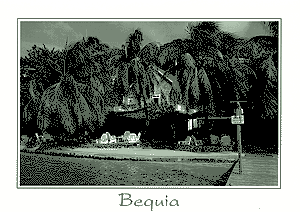
The downtown part of Bequia that I managed to see was a somewhat
disappointing loud, touristy zone with many chartered boats in the
harbour. Would have liked to visit the model boatbuilding museum but it
was closed. The Plantation (Guest) House was abandoned and overgrown and would have been a good place to stay in its day — yielded some 12hr
photos of the statuary dispersed on the grounds.
Did a quick listen and a few edits of the Barracouda and Bequia
recordings, some good stuff! Got all the various batteries recharging.
J’s still didn’t have the Pinehill pineapple juice that I like and the
little girl still cries when she sees me, even when I take my hat off.
Bought some more groceries in Clifton (mostly at Y’s store): pancake
mix, guava jelly, Jamaican cinnamon tea, dozen eggs ($10EC), cheese,
popcorn, Canadian split yellow peas (which I added to my beans and green
lentil soak) and popcorn($3EC), 1 litre Belgian soya oil (12.25 EC),
bottle of peanuts (to take with me to Gordon’s when I have a cold
Guiness), Ocean Spray 100% cranberry-pomegranate juice ($19.50EC to mix with the rum), and Crix crackers. Thinking of another omelette on toast
with those peppers tomorrow along with a very little rice and beans
(just to sample them.)
Talked with Y about the island uprising and her parents’ (as prominent
residents they were suspect and imprisoned but not beaten like the
rest), soda bottling business. Related my story about my similar idea
for unusual flavoured sodas along with reproduced photo-art on the
labels, and how I probably talked about it too much as Jones’ Soda Co in
Seattle did just that.
These entries remind me of Twittering a little. I can remember seeing
the Twitter offices in South Park across the street where I worked at
Wired in Frisco, and not fully understanding the implications and appeal
of an application that merely seemed a restrictive, abbreviated form of
email or listservs. Apparently Twitterers have currently donated $22 US
million to Haiti relief efforts by texting ‘Haiti’ to 90999. (I’ll have
to find out how this works.)
Just before heading out to the pier to work on the watercolours, I
heated-up the SV mkt peanuts with salt and curry. Have to try this with
green peanuts and maybe other spices… a marketing idea? Read some more
of a used book I lifted from one of the unattended Chatham beach bars :
Ian Rankin’s “Hide & Seek” a Scottish detective novel. But I’m mostly
interested in a Penguin classic tome at Ericka’s book exchange, although
it’s not too bad a beach-read. The beans are a-boiling but I need to
remember to add the lentils later as they get mushy by the time the
beans are done.
Wood from Brazil Tiles from Turkey Marble from Italy Wine from Chile
Linens from Egypt Crystal from Ireland Lighting from the UK Champagne
from France White Goods from China Furniture from Indonesia
— shipping container advertisement
Perhaps by buying all those groceries from Y’s store yesterday I
confirmed my intention to pay additional months’ rent and this helped
realize new repairs: (this also means some noise and I’ve learned that
leaving your curtains tied-back is an invitation for anyone to come-up
and speak with you, as one of the workers asked for a box of matches
while scanning the interior of my apt.) The roof of the residence and
former GH across the road is being replaced (a 12hr subject); perhaps my
rent is somehow helping to rehabilitate this fanciful building. More
great sounds too but I’m already running low on MDs. The new pre-amp
with three settings (zero, low, and high gain) is getting some getting
used to, and the battery gave-out when I first started recording from my
GH window, so I had to delete some attempts… The high setting causes
the recording to readily disintegrate with minor changes in volume, ie,
sudden wind gusts.
antimacassars Kick ’em Jenny volcano
Although situated farther south than the path of frequent tropical
storms (between August and October), the last hurricane, Janet in 1955
totally destroyed the island. Earlier recorded hurricanes occurred in
1898, 1831, 1817, 1780, 1768, 1675, and 1625. The temperature hardly
changes with an annual average of 27.5C.
The locals still complain that the gov’t doesn’t do anything for them.
They are a long way from SV and they feel closer ties with Grenada and
maybe T&T. Interesting to consider that Grenada’s and SVG’s most
‘outlying’ islands (PM and UI) are so close to each other — 30 minutes
by speedboat with no formal immigration checkpoints.)
The first five months of the year are typically the dry season, it
really is a dry island entirely dependent on that little rain for water.
This would explain the lack of crops and the early cotton plantations
which eventually depleted much of the soil. The Salt Pond is apparently
a good bird habitat, I need to find out how the salt is/was collected…
blind bit of difference all the hammering is getting to me so I’ll head
down the beach… Someone tore-out possibly the climatic 15 pages
toward the end of Hide & Seek. I’m usually suspicious of fiction’s
resolutions anyway. Might have made another UW film, a crab’s eye view
of the beach/sea, called Life is a Waste of Time. Hard to tell as the
tiny camera ‘froze’ and I have no way of viewing what may be recorded on
the SD card. One rooster, several hens and one adolescent chicken came
around for popcorn this evening. I called PSV to arrange a ‘tour’
tomorrow morning; they wanted to know if I wanted breakfast — like I
could afford anything on that private island (others: are as well or are
already headed in that direction).. well maybe a glass of water: it’s a
fasting day. Be curious to poke around though, not sure if they’ll
charge me for the boat ride or not. Laurie just called back to say that
Captain Maurice on the Zeus II will pick me up at 11 and return at 1, so
a brief visit perhaps. Y is flying to SV to attend an aunt’s funeral, so
won’t be back until Fri. The laundry can wait until then. As you might
expect, the cinnamon tea smells nice, although it’s probably pretty old,
but doesn’t have a lot of taste.
Decided at the last to cancel my tour of PSV just in case I need that
free trip to get to PM (and I’d prefer a little more time there),
although Maurice seemed to think a fee was in order for going to PM
because he would be “facilitating” me — can’t have that!
Exchanged my book for a collection of Italo Calvino short stories.
Borrowed “A Natural History Monograph of Union Island” by Jacques
Daudin, from the Clifton Community Library. It really was open at three,
but not a lot there; the young librarian had purple eyeshadow and will
allow me to borrow what little reference material they have. I recorded
ten minutes of school sounds and having asked a teacher about the
library she agreed to show me some photocopied material tomorrow
morning. Struck up a deal at the Rasta music shop (10 copied CDs for
100EC), mostly because they had a few steel pan CDs, along with Burning
Spear, Steel Pulse, Sizzla, Culture Mix, Reggae compilation, DJ
Loudmouth, and probably a spoken-word Angela Davis work entitled “The
Prison Industrial Complex.” The chickens spotted me coming back from
reading my Union Island book on the pier, so I fed them the leftover
popcorn and unpopped kernels from yesterday.
Serious rain this morning just as I finished my usual omelette with rice
and beans. Though I’d visit the schoolteacher and then walk around
towards Ashton and hang-out there for the day. There’s one track on the
map I’ve not been along that runs past places mentioned in the UI book:
Colin Campbell and Water Rock Reserve where there’s apparently old
growth forest. I’m taking fewer and fewer photos as the island typically
sort of ‘seals-over.’
“Bad weather for we today.” Still waiting for the sky to clear a little
more. My new radio either gobbles-up battery-power, it does have a lot
fancy features, or the AA’s are not fully charging as I can now rarely
have it play for even half a day. I’m trying the dual voltage cord from
the Zaurus to simultaneously charge and play the radio. The output
voltage is lower and the amperage is different but the plug fits and it
seems to be ok so far.
Watched Obama’s State of the Union address last night: very impressive
and I hope it all really happens. His picture is posted in many shops
and boats here.
Found the beginning of the track through Water Rock Reserve but I’ll
need long pants to get through the low-lying burn bushes; couldn’t see
Fort Irene… Bought some Pineapple-Passionfruit ($7.50EC) and Pineapple
($6.75EC) juice, and a bag of Lam’s Caribbean Style Chow Mein Noodles
($6.25EC) from Guyana.
Changed my mind about going to SV this morning. It is a little expensive
once you add it all up: a little over $100US and it’s an arduous trip
being tossed around on the water for five+ hours each way. I’d really
like to see the Montreal Gardens and I’d only have a couple of hours for
that and the Bequia Music festival… maybe later in February when the
memory of the last trip has faded. Made another onion, pepper, cheese,
tomato omelette along with rice and beans. Need to buy some more onions
and bread. Will put the laundry out this morning. D is in snowy Kentucky
headed for Florida.
Made a single pancake with guava jelly — a little undercooked. Watered
the palm plants outside. Read another Calvino war-story. Will head into
Ashton soon and check-out Uncle’s Recreation Centre and the Library and
buy some groceries.
Had a little nap then remembered the four little bags of peanuts I’d
purchased for my trip, and gobbled them-up accompanied by a
pineapple-rum drink and another short-story. Fed the chickens some more
popcorn; they now run to the porch if they see me. Took yet another 12hr
“establishing shot” of B’s house. Read two more stories.
Asked Y if her family was Garifuna — hope I wasn’t offensive (there
probably aren’t many genealogical records) but apparently they have
higher cheekbones and flatter foreheads,,, this is consistent with G
people I met in Belize. I never quite know how much to say about my GIP
books,’sometimes it’s helpful other times it causes trouble and
suspicion.
Walked past a single gravel hammerer (need at least two for a good
recording) and through Ashton to the snackette next to the high school
where I had a marginally cool Guiness and asked about Uncle’s that’s
apparently open on Saturdays for bingo. So bought some groceries from
the little shop underneath the Seashell GH: Daisy Chicken Luncheon Meat
from Brazil in a tin with key ($3.50EC) to go with the Ghanian noodles,
big bag of onions ($5.50EC), another (probably the last on the island)
Pinehill pineapple juice, black-eyed peas ($5.50EC), wholewheat bread
($4.00EC), and three tiny bags of Jamaican almonds @ $3EC/ea.
Searchlight SV newspaper headline: “Robbery suspect gives cops chase
through Richmond Hill: COLLARED!” I inadvertently dropped my newspaper on the road and someone in a minivan stopped to alert me but despite being heavily laden with groceries, no one has ever offered me a ride; there aren’t that many roads/destinations… It’s a dramatically specific island whose 10 million year old volcanic profile is readily if still eerily recognizable. Y couldn’t tell me who Miss Irene was either. I told her that I was feeding the chickens in her absence and that they now ran to the porch when they saw me. If I had related this to Shirley in Belize, she would have been chuckling longer than the chickens.
Cooked some noodles with the Brazilian mystery-chicken: I’m still
getting thinner and probably need more of something.
Another windy day; the mosquitos and sandflies still swarmed around me
the minute I stood outside.
Almost everyone here has either lived in Canada, usually Toronto, or
knows someone who does… I think I said this already… Traded my
Calvino stories for “The Mermaid and the Drunks” -Ben Richards and
“Oryx and Crake” -Margaret Atwood. Learned that the MV Jasper leaves
from Ashton on Mon and Thurs at 6 or 6:30 a.m. So nay go back that way,
bypassing PM and saving some money, if there are no immigration
issues.Bought an eggplant, papaya and cucumber for $16EC; a big 2kg bag
of popcorn for $17EC at Kash & Karry and another Marouks peanut butter
at J’s for $9.95. Will attempt to steam the eggplant and then see if
there’s a bingo game to record in Ashton.
I plan to add the eggplant to my morning omelette. Bingo doesn’t start
until 10:30 p.m. — too late for me. Had a Hairoun Indian Quinine Tonic
Water. Found the track up to Mount Taboi but I was too tired and
carrying my recording gear and novel. Most stores close around noon or
so, and the one that sells refrigerated eggs didn’t reopen until six so
the walk over was unproductive. Fed the chickens and read my book in the
sun.
The other night I dreamt that I was laboriously spreading thin coatings
of honey across immense expanses of a church flagstone floor. I’m only
now beginning to feel like I’m living on this island – the days are
becoming longer, even languid – I suppose I’m always anxious about how
to get off the island in order to begin to get home (there are always
snags and setbacks) but then I eventually succumb a little to the
eventualities… but maybe that anxiety is part of the island
definition. I know all about being excluded, isolated and denied. Is
this a kind of revenge or appeasement? “…the sudden disturbance of
wings triggered by a faraway noise, the startled ricochet and truncated
flight of caged birds…
“In the hour of shipwreck and darkness, no one will save you…”
History is ours and it is made by the people. Do we really believe this
any longer? The great avenues will once more open through which free
people will pass to build a better society. Just sat around all day and
read. Despite the huge breakfast I just had two guava-jelly pancakes…
Really packed it away: later I had a bowl of the chicken chow mein
noodles, which maybe disrupted my sleep. As usual, I’m often trying to
get somewhere in my dreams. I remember purchasing a “yellow” economy
bullfighting ticket but then discovering that there weren’t many of
those colored-coded seats available. Sounding windy again this morning
despite being very still and warm last night. I’ve made some cinnamon
tea and reading “Oryx and Crake” while waiting for daylight and a walk
into town to pay Shirley my rent. Will make a note of the electric meter
reading and also ask at Erika’s about any customs/immigration procedures
and whether MV Jasper arrives at the main jetty in Carriacou that the
Osprey uses, (as I don’t want to have to lug these heavy bags around the
island via dollar-bus from the small pier.) Exit strategies. Finished
“Mermaid and the Drunks” yesterday– various kinds of exile, return and
self-discovery. Pretty good, with lent insight into Chile’s political
strife and culture. The island of Chiloe was mentioned so I’ll have to
research it assuming it’s not fictional. May bring along my walking
stick and venture some ways along the track to Mt Taboi.
dirtysockpuppets.com
Electricity (I asked the guard at the power station) costs about
$.90EC/kwh so by my calculations my bill for January should be around
$84EC. Ynonne’s sister’s name (who works i the clothing shop) is Marie
(not Shirley.) Anyway, I asked for Shirley and was told something bit
her foot on the beach and the swelling prevented her from coming into
work — so ended up giving $1100EC to Y in the supermarket for
February’s rent and then headed part way up the mountain before the
track got too overgrown. Still had some good views of PSV, PM,
Carriacou, Palm and Frigate islands. Bought eggs, more chow mein
noodles, cheese. peanuts, orange juice, and a tonic water on my way home
through Ashton. Soaking some black-eyed peas and kidney beans and the
yellow peas separately. Bought refrigerated eggs that came in about a
week ago, so we’ll see how they compare.
When the water’s moving faster than the boat, you can’t control a thing.
Another eggplant, onion, pepper. cheese and tomato omelette. The
chickens are calling. Still waiting for my rent receipt. I have learned
with frequent good reason, to mistrust nearly everyone, especially the
institutionalized, and when people sense this they feel especially
obligated/permitted to cheat, betray and steal. Self-fulfilling
dialectic in the absence of sufficient positive outcome. nothing I can
do. The beans are still simmering, then I’ll cook the lentils with the
rice and green peas. Kingdom, Phylum, Class, Order, Family, Genus,
Species. Finished “Oryx and Crake” — a little pedantic at times and
laced with typical Canadian support prerequisites, but a good dystopian
SF tale occasionally sprinkled sparingly with cautious optimism.
oryxandcrake.com Will head into Clifton for more from the book exchange.

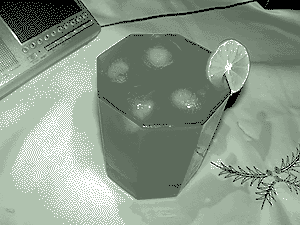
Well, the MV Jasper isn’t going to work because the captain checks to see that you’ve checked-out of Union — I’ve not officially exited Grenada nor entered SVG, so I can’t begin to exit… so, I’m dependent on water-taxis (probably a lot more expensive from this side), or goodol’ (drunken/stoned) Mr Bones to get me back to PM in time to catch the Osprey to Carriacou/Grenada and the plane home. Y spotted me from the supermarket and gave me a rent receipt in an envelope. Was she planning on slipping it under my door? Maybe I ask too many questions or am objectionable in some other way. The little girl at J’s certainly thought so again — one look and her eyes widened and she started bawling. Perhaps I should bring a little treat for her next time. No tomatoes; should have bought them yesterday. Picked up a copy of “Vincy Carnival magazine 2009(EC10)” from the Determination Bar (I have a hard time understanding what’s he’s saying — actually I’d prefer another distinct language), he brought me a fresh copy… and three ‘new’ books from Ericka’s (can’t figure out: The Club Dumas (Arturo Perez-Reverte), Catapult (Jim Paul), and the Penguin tome, Clayhanger (Arnold Bennett.)
Every once in a while the saltpond glazes over and people come to gather
up the salt. I might get some, it’s probably zestier than the regular
stuff… Y had no idea… other than warning me that I might burn my
feet…. so how is that?
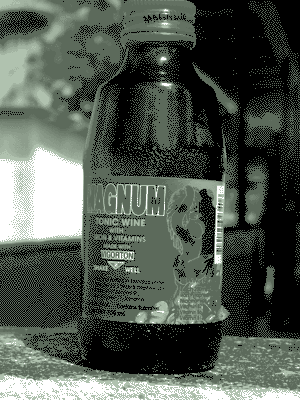
Sent another matchbox (full of spent matches) to Rudd Janssen. The
postal people thought it was quite funny but insisted that I wrap it in
paper, which they supplied along with scissors, pencil and tape
($1.35EC) A chair has materialized out of nowhere on the pier and I now
regularly sit there to peruse my exchanged novels but after again
realizing/reading the exclusive support mechanism, I’m not so keen.
Instead I took a chance and petted the dogs.
Walked down and around (got some good 12hr pics of boulders in a row)
past Fort Hill and out to the end of the airport runway and back into
town where I bought several tomatoes, a mango and a sporphina (? a pale
green lumpy vegetable that I’m steaming now for my omelette tomorrow) =
$16EC Out to the pier to read Catapult… it recounts the tribulations
of building a rock-throwing device as an artwork in San Francisco
(Headlands Center) amid much wryly anecdotal commentary and recounted
histories. The chickens followed me back from the pier and right up onto
the porch where they stare in the windows at me. I found a few popcorn
kernels beside the stove — that’s all I had and it clearly wasn’t
sufficient. I’ll have to make a bigger batch tomorrow. Thinking of maybe
visiting the Montreal Gardens for three days if I can find a cheap place
to stay nearby. I’d leave on the MV Gemstar Wednesday and come back on
the special Saturday Barracouda run that stops long enough to see a bit
of Canouan and Mayreau.

Dragonflies eat mosquito larvae who also ‘nest’ in land-crab burrows.
The rooster starts crowing about a quarter after four; I’m up, brushed,
flossed, Deeted and shaved and breakfasted by five. Finished the
Catapult.; enjoyed the references to the Bay area. Apparently just
shooting a film in SF or NYC pretty nuch guarantees a ROI from local
audiences alone. Made some popcorn for me and the chickens. Walked into
town and traded Catapult for Angle of Repose (Wallace Stegner) at
Erika’s. Maybe I should be cautious when going in there as they do
process Custom and Immigration clearances. Even more salt-gatherers at
The Pond — word has spread. The Club Dumas is a book about old books. I
called the Montreal Gardens to ask if there were any guesthouses to stay
either there or nearby but honestly couldn’t begin to understand what he
said. I unsuccessfully tried texting them also. I was maybe hoping that
as an artist and aspiring gardener I might help-out in exchange for a
simple place to stay. Next I phoned the SVG Tourist Office: I can’t
believe that there’s no where to stay near their primary tourist site.
Maybe it’s not all it’s cracked-up to be. I’m still mindful of the ten+
hour sea voyage there and back. I may try asking in-person in Clifton…
(but there are officious immigration people there.) The chickens came
right up on the porch again for popcorn. They really do seem to
recognize me. In the early mornings they seem to hang out in the cool
mangroves round the saltpond. New neighbours from B.C. in a house within the ‘coconut compound’ which includes the pier. This middle-aged couple often briskly walk back and forth along the short stretch of beach for
some pre-determined time (they glance at their watches before setting
off, and most of the dogs seem delighted to follow along.) I see that
“the Englishman” way up on the hill above the airport has a
(non-operating) wind-generator but it’s curious that there aren’t any
(that I’ve seen) alternative energy devices like solar-panels on an
island that gets a lot or sun and little rain.
MV BARRACOUDA rates:
Kingstown to Bequia $25; Kingstown to Canouan $40; Kingstown to Mayreau $45; Kingstown to Union $50; Bequia to Canouan $35; Bequia to Mayreau $40; Bequia to Union $45; Canouan to Union $40; Canouan to Mayreau $30; Mayreau to Union $30; Children (6-16yrs): $20
I wonder if there’s an early morning flight from Union to Grenada in
time to catch my flight home? My luggage would be overweight and there’s
still the visa issue, but I’d save on the cost of expensive
accommodation in Grenada and taxi fare to the airport and hotel and
ferry/water-taxi costs (this could add-up to say $270US or more); less
lugging of baggage and it would less stressful — fewer things could go
wrong. Would immigration insist that I return to Grenada to checkouts
and then return to SVG to check-in — only to checkout of SVG and
check-in and checkout of Grenada? similar to what E said his sister had
to do? It doesn’t seem that I can check-in or out of SVG because I
didn’t checkout of Grenada and in order to do that I can only return the
way I came or surreptitiously take a water-taxi to Carriacou and
checkout but having done either trip I may as well continue on to
Grenada. Or would SVG just scold me and not stamp my passport (?) and
would Grenada let me in without the SVG exit stamp? I may phone Erika’s
and ask somewhat-anonymously about all this. It may be too expensive
anyway or there may not be an early flight or the puddle-jumper may just
refuse my heavy bags… Cinnamon tea this morning. Hope someone
remembers to pick-up my laundry this morning. Oh, it’s suddenly gone
from the porch. There’s a tiny high-pitched mosquito in here; you open
the door for even a few seconds and in they come. I kill them by
clapping my hands together. The air pressure from opposite directions
may be immobilizing them.
Bought a nice ‘dolphin’ steak for tomorrow. Sat out from of Mitchell’s
hardware with cold tonic water reading the Vincentian (Landmark
Decision: Police Guilty) and watching the goings-on. Bought a bottle of
Sunset rum and box of orange juice from J’s. Almost finished read ing
The Club Dumas. I’ll have to read The Three Musketeers, around which it
is loosely based.. Recorded the rasta chanting with the new moon but one
of the channels all but dropped-out; I really like it so I’ll have to
see if I can re-balance it once home. I see there’s another lunar event
this Saturday so I’ll be listening.
The chickens are plucking around outside on the porch this morning
despite being only moderately interested in the popcorn yesterday; there
are too many mosquitos and flies right now to stand outside. Another
three-egg scramble (not really an omelette): will cook the dolphin steak
later in the day. Running low on bread, butter, juice, peppers and
cheese.
“You don’t have to go…” “Without finding out the answer?” “Without
undergoing the test. You have the answer within you.” “But the end
result is the same: damnation. You have to pay with the innocence of
your soul.”
As for the devil, he is no more than God’s pain; the wraith if a
dictator caught in his own trap, The story told by the winners.
Surprisingly, I consumed all of the two pounds of dolphin before one. I
did have a little nap and this may help me stay up a little later for
Clifton’s Saturday night. Finished The Club Dumais and just barely
beginning to understand what it may be like to live here in amongst the
remnants of a volcano and wicked colonial histories. Yah mon.
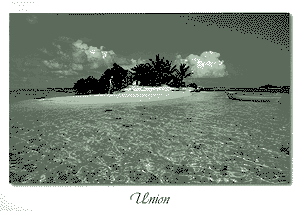
Trotted into town after eating all that food and a nap… peanuts from
J’s (always crawling with little children) and exchanged The Club Dunas
for “In the Cut” (Susanna Moore) and there’s only an early morning
flight to Grenada on Sunday at 7:30 a.m. not on Mondays, but it’s only
about 190EC… So that’s surprisingly cheap and now worth
considering….
Recorded the Saturday evening street sounds. A little random and not at
all like the sequestered murmurings on PM. Sucked back a few Guinesses
and one bad Danish Stout along with a small chicken and chips ($8EC.)
Came back via Maglite; never have felt even vaguely threatened here,
though I’m usually asleep by eight. Pretty sure I won’t feel at all
hungry tomorrow. It’s odd but I’m now becoming less and less interested
in eating/drinking. It rarely seems worth the effort. Many French
yachties here as well, they seem very enclosed within their
language/culture. One big catamaran parked over a local’s tiny
scuffed-up wooden outboard and of course he and onlookers were upset. It
probably wasn’t a big deal in the grand scheme of things but in the
marine world there’s usually much more respect accorded to any boat and
its skipper. Just impolite and I’m afraid typically Francais.
walked through Aston (noticed another road cutting up and inland which
I’ll try another day) and around to Clifton where I bought butter, two
tomatoes, 3 sporphina, eggplant ($30 EC) and then to Y’s supermarket for
bread ($4EC Lambi’s and the little red bakery have bread too but it’s
lighter than air). Just finished steaming a couple of the vegetables for
my usual egg scramble tomorrow. Thinking I’ll try setting up the PSV
tour for the last Saturday and have E pick me up there for lunch at his
restaurant before the ferry leaves at 3. So my transport will be free
and I just pay for a nice lunch, perhaps some conch, which I don’t think
I’ve ever tried. I’ll arrange a ride to PM for Sunday with Bones as a
backup plan. Still on the lookout for callaloo soup, I,m asking too
early in the day. OTOH I’ve never seen E’s boat move in the month I was
there… Some guy was selling chicken foot soup from the back of his car
but it didn’t look like it was anything more than the feet in water, so
I passed. Fed the chickens, mopped the floor a little, turned the fridge
back on — I’ve been trying to minimize the electric bill, and will head
out to the pier to read In the Cut, perhaps walking into Clifton around
3 to check for fish.
No fish mongers around today. perhaps there’s no fishing on Sunday.
Nearly everything closes up by mid-day and some re-open in the evening.
Went into the Clifton Beach sports bar that my neighbour Jule and her
husband (from NY) lease and operate. Very breezy with a good view of
harbour activity. Bought a tonic water ($4EC) Told me that SVG visas are
only good for 30 days. Just as well that I don’t have one. Have begun
reading Angle of Repose.
Thinking about how ‘dead’ it was in Clifton on Sunday; perhaps I should
move my departure up a day, leaving for PSV on Fri with Bones as a
back-up Saturday. I’d like to chat a little more with J about how they
do business and residency in SVG. D texted me that he was enjoying his
Christmas book on newspaper columnists. I bought it from a little shop
(Post-Hip) in Multnomah Village last summer; the proprietor rattled-on
enthusiastically about the various older writers I knew little about.
The chickens are squawking for popcorn. Y has left for the store. The
dogs are alerted to some irregularity. The waves continue to break
on-shore. I read my book waiting for sunrise. Much as I like the hot and
dry climate it could be frustrating to live here without an easily
irrigated garden. Antimacassars: I need to again be angry but stay that
way, despising authority, effecting revenge, right the wrongs, stating
the truth and ending this nonsense. In addition to spontaneously singing
songs, islanders seemingly love to burn things. It can be a big pile of
brush or garbage but even a small pile of raked leaves invokes the
smoke. It’s also curious how people with sand in place of lawns are
obsessed with raking leaves (only to have them all blow back the next
day), unless it feeds the desire to burn… Papaya trees are fabled to
not be planted too close to bedroom windows as they cause bad dreams,
but that folklore seems to be largely disregarded here. I think I
finally categorically dislike the computerized voices in reggae songs.
While I understand how the practise eliminates the need for traditional
vocal skills (any wharbbling can be brought into tune/line), it also
excludes anything non-catagorizable or even ‘new.’ Ynonne spotted me
coming my usual way into town and asked me for the difference in a $80EC
power bill, a big portion of which is government taxes. And apparently
solar technology is not permitted! (The Englishman on the hilltop has a
wind turbine however.) Traded …Cut for Chuang-Tzu (A Classic of Tao)
… well, no one else would read it. I asked again about the fare to GND
but I’ve forgotten. Also about private boats going to Carriacou for
their Carnival, also at the Neptune Bar (Julia) but nothing solid.
Watched as the police searched passengers for ganja when disembarking
the Barracuda from SV. I was breaking up some ice and Y came around to
see what was going on; she saw me at the bar and thought I was still ‘in
Clifton… so that’s good.
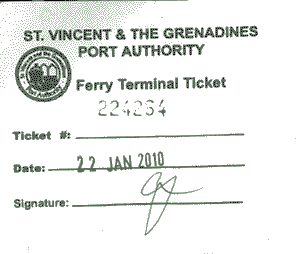
Watched an interesting TV programme last night about the history of Soul
Train. Michael Jackson _didn’t invent the moon-walk, it was some of the
unpaid ST dancers. White PVC tubing is frequently used here in
ballistades, furniture, and filled with concrete for columns.You can see
stars in the daytime from deep in a well. Listened to Wire’s Below the
Radar and Somic Frequencies mp3s on my new little Cowan player while out this morning: Went for what turned out to be a very long walk. First
over and through Ashton and took the cutoff up and around and eventually
to Clifton where I was going to buy what I thought I remembered seeing
in Lambi’s: refrigerated eggs, but no. I did buy some little very hot
red peppers like I had from St Vincent. 3 for $1EC and 3 tiny bananas
(she called them ‘figs’, also 3 for $1EC.) so, I walked back to Ashton,
this time around the coast and bought my chilled eggs from Henderson’s
again. Then up to the shop underneath SeaShell? for some cheese, pancake
mix, kidney beans, rice, powdered cocoanut milk ($27EC) Then back
through Baddu and home. The clerk told me Salt Pond salt was all but
gone so I took an empty peanut butter jar down there and filled it with
some fairly clean flakes. Then over to J’s before she closes mid-day for
more rum and orange juice ($35.50EC) All set for tomorrow’s meal. The
days are long and all this shopping keeps me busy and active. Now about
to resume my book; chapter four of Angle of Repose which so far recounts
the lives of newly arrived New Englanders in frontier California late
19thC. It’s nice to see all the goats, sheep and cows wandering down the
roads, Several cows have now just begun grazing in the neighbour’s
yard, ignoring all the dogs’ objections.
A restless night with dreams of violent confrontations. The rooster
crowed a little after 5. Another 3-egg (one of which was quite old as
the yolk broke when landing in the pan), scramble. Reading ‘Repose’
again, into chapter 8; I may buy this book for D; I already have a much
better perspective on the Hudson River school of thought and painting
that really was _exported to the western ‘frontier.’Not sure what to do
today; I’ll probably walk over to Chatham Bay again tomorrow as it’s a
non-eating day sometimes needing some distraction. I must remember to
make some guave pancakes today; I have a lot of mix and jelly ‘to
eat-up’ (as M used to say.) Making some popcorn; best to get the pot and
oil very before adding the kernels. Looking forward to the cheap
overproof rums in PM, if that’s still possible after the new VAT this
month. You can get three times the amount of rum for less than a 750ml
bottle costs here. Apparently this stuff is so flammable that it’s
prohibited on most airlines. Or did I say that before…?
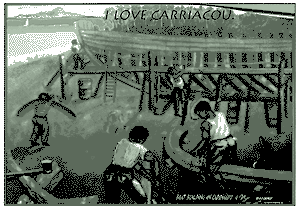
Was thinking yesterday while out on the pier reading Repose, that I
should make an ebook from all of M’s saved greeting cards. Maybe D could
scan them for me? I wonder if she saved the envelopes as well? Did the
Ashton-Cliford loop and bought some eggplant (3 short squat ones for
$8EC) All cooked and ready for tomorrow. Only 7 or 8 meals left here,
not sure I’ll get through all the food I have in the cupboards.
New Harmony, Fruitland, The Icarians, Amana, Homestead, The Mennonites, The Amish, The Hutterites, The Shakers, The United Order of Zion, The Oneida Colony…
Finished ‘Angle of Repose” — the angle at which rolling stones and dirt
come to rest, or death. Interesting NatGeo TV programme about the moon
and its stabilizing significance for the earth. It’s apparently slowly
moving away and will eventually cause the earth to wobble more on its
axis, leading to dramatic climatic changes such as another ice age. The
highest tides occur when the gravitational effects of earth, moon and
sun are aligned.
Up early: about 2:30 — maybe I was just hungry. The rooster (there’s
only one other that I can hear at some distance), first crowed at
quarter to four. (In small coastal villages i Belize they crowed at a
few specific and regular times each morning, locals used to mark time by
this phenomena, ie.,, “I’ll meet you at the second cock.” It’s two
o’cock? ;) Have begun ‘Clayhanger.’ and will return the library book and
do another book exchange at Erika’s. I should work on the watercolours
though and need to make a point of making more pinhole photos. Y is away
and so the laundry was done yesterday (Thursday).
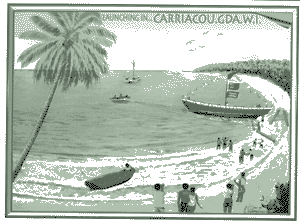
No, she changed her mind and goes on Monday. ($280? EC) She and her
Rasta brother are always well dressed. Many chickens to greet my return
this afternoon. Tried to return my book to the library, next to the
primary school, but it was closed and a track ‘n’ field event was
happenin.’ Bought a chicken wing and peanuts ($2EC) and took a couple’of
snaps. Pretty exciting; again, those long tropic thighs make for good
runners. Three teams each wearing red, green or yellow T-shirts. Also
tried to mail some postcards but it seemed I was too late. Did manage to
exchange another book for “Kings in Grass Castles.” Something about
Australia, again in the mid 1800’s. Bought a couple of Guiness and
salted peanuts from the Kash ‘n’ Karry but noticed the old expiration
date. B and her old white partner were there as often, buying supplies
including water. I guess they don’t have a tank (?) Earlier I worked on
the w/c’s and read 60 odd pages about Victorian hardship. The coconut (I
bought one today $3EC), compound is getting quite spruced-up! New roof,
paint and yard work. Apparently tin rooves are cooler than shingle and
yield better rainwater runoff…. Also picked-up a copy of the February
Caribbean Compass — a cool little paper, maybe I could work there?
as-if. Articles on the San Blas Islands and Mt Taboi here on Union
Island. And, the Vincentian: 20 Years for Killing his M.
A Libyan (Islamic = no interest paid) bank is expected to be established
in St Kitts. It will support the new international airport and provide
college scholarships. The birds are chirping outside despite it being
nearly dark. Valentine’s Day (Monday) is apparently a big event here.
Sat out on the pier most of the day reading, watching the breakers and
painting. ‘Clayhanger’ concerns a Victorian printer and architect so
much more interesting than the apologetic, academic introduction would
have you believe. Got me thinking again of incorporating letterpress
elements in the red drawings; perhaps white photopolymer plates made
from the painted picture fragments (SSS.) Went downtown and bought a few
nice tomatoes and rum and (unfortunately, sweetened OJ) from J’s. Called
the Caribbean Cottage Club in Grenada about staying the last three days
in February. I’d like to visit the Grenada Chocolate factory there
(Portland entrepreneurs.) Waiting to record the Rasta as the sunsets…
(Guests moved-in below which may have dissuaded the performance.)
Yes, it’s the young white skateboarder, I’ve seen gliding around town,
with the blond Rasta locks, no doubt attracted by the occasional
moderate surfing swells.
38.15 LSB(?) is supposed to be the Caribbean Emergency and Weather
station at 6:30 a.m. but hear nothing but static, on my SSB radio. The
Internet has doomed many SW broadcasts. It was so cool to see people
clustered around SW radios in Bangladesh, and hearing some English
suddenly was strange. “Transformed … by something without a name in
the air which the mind breathes.”
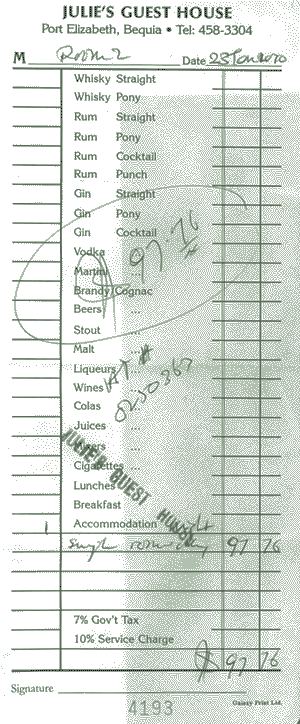
I may have accidentally shut-off the water valve leading from the tanks
on the roof, so running the pump for an hour was probably unnecessary. Y
told me that the trees were trimmed back from the house so the possums
(which I’ve never seen), in their nighttime quest for the fowl nesting
in the trees, wouldn’t get up there and rattle around on the roof. It’s
apparently been unusually dry this year so I didn’t recognize the
spotted, spikey tree without leaves and now just a few buds, behind the
house as a frangipani. Erosion on the beach here is quite severe. I
could watch big chunks of beach sand being washed-out. In the short time
I’ve been here I guess the shoreline has receded about a foot. Kind of a
helpless feeling; I guess you can pay a lot of money to have boulders
dumped as a breakwater which helps a little. Y thinks it’s worse since a
little island was eliminated to the East when the airport was expanded.
The last batch of beans are furiously boiling. From the pier I can see
(from right/East to left/West) the Tobago Keys, Mayreau, Canouaon, and
the distant peaks of St Vincent. I think Bequia, which is East of SV, is
hidden behind Canouaon. In Ashton Harbour there is the abandoned,
sketchy, outline of an unpopular Italian marina development; quite a few
empty houses as well throughout the island. Once the beans are done I’ll
start the lentils and coconut rice then retire to the pier to read and
take some more pinhole photos once the sun climbs up. (I’m looking
forward to having a Papa Murphy Delite pizza once back in Portland.)
Later this afternoon I’ll attempt to return my library book and look for
fish, which goes fast as much of the minimal catch is pre-sold I think.
Much of my life has been an impending disaster, packed with trouble and
economic woe, so I’m getting a little anxious about getting back to
Grenada and home to see what has conspired in my absence, although D
wants me to stop-over in Florida for a few days. This would be costly
and I need to pay the rent on the ‘treehouse,’ which a showed Y a
picture of yesterday. I pretty much cooked the Canadian lentils, then
slowly added/stirred the coconut milk powder into the same water
followed by the rice being brought to a boil and cover and simmer for 10
minutes. I’ll have leftover uncooked rice which I’ll leave for Y or
someone. I’ll look down the beach in the other direction for my ‘popcorn
bowl’ that the dogs ran-off with yesterday. On page 267 of Clayhanger
with cinnamon tea on the side. Very breezy and very hot today. Made a
nice little film of what I think may be a Yellow-crowned Night-Heron
stalking, catching and eventually swallowing-whole a big beach crab. He
looks like a heron but with a duck-like bill. I think I have enough food
here to last until my departure for PM. One more 3-egg scramble, then
pancakes, chow-mein noodles, tomatoes, rice & beans, and pasta with
tinned-mackerel should be enough for 5 more meals. On page 426 of
Clayhanger
Another hot one; walked into town mid-day to exchange Clayhanger for
something else but Erika’s wasn’t open. Bought 2 lbs of fresh fish that
turned out to be Kingfish and not Dolphin — buggers! — if I can’t see
the head it’s harder to tell. (Same price but Dolphin’s much better. I
thought it didn’t look very red but I guessed it was a younger fish or
something. What can you believe?) Sweat’s rolling down my back: out to
the pier. The chickens all followed me back and cheered me up. Started
to read “Chuang-Tzu, a Classic of Tao.” Wondering about Florida again.
(Interesting TV programme about the spreading Burmese/African python
invasion in the Everglades ~ released exotic pets that grew too
large/expensive.) Spotted a roadway up towards “the Englishman’s house”
which I think I’ll investigate this morning before it gets too hot.
Fewer mosquito (bites) this month (Feb), perhaps it’s the dry weather.
Well this is the first day that I didn’t go for a walk somewhere, partly
because I was waiting for my laundry to be picked-up (never happened; I
looked at the washing machine but it was disconnected for some reason)
and I was luxuriating in the 90F sun. Note to myself: buy dominoes and
perhaps a book of dominoes once in Grenada. Gobbled down the rest of the
fish and a big bowl of spicy chow-mein) the little Corgi-like dog was
vigorously wagging his tail while scrunching the scraps.
“Subtract the days and there is no year. What has nothing within it has
nothing without.”
Chuang-Tzu, inner chapter 25, 319BC
Well, the roadway just lead to the fort; I didn’t recognize the house
because the gate was closed last time I was up there. Walked around the
island through Ashton and Baddu, read on the pier, then texted and
called Bones: he says don’t worry he’ll pick me up on the 26th. So
that’s a relief. To celebrate I walked over to J’s where low and behold
she had pineapple juice for me!
“With the abandonment of fixed goals, the dissolution of rigid
categories, the focus of attention roams freely over the endlessly
changing panorama, and responses spring directly from the energies
inside.”
Killed _one of the big brown bugs; they’re very fast. Last of the eggs,
precooked vegetables; little cheese, bread, cooking oil, tomatoes,
peppers, limes remaining… lots of pancake mix, pasta and r&b still.
18th C treaties latitudinally divided the Grenadines between the British
and French. The area on Carriacou known as Gun Point and the headland on PM known as the Breeza apparently belong to St Vincent.
The true man casts away his knowledge to the ants, discovers how to
estimate from the fish, casts away his intentions to the sheep.
“Spillover saying” is named after a kind of vessel designed to tip and
right itself when filled too near the brim. Taoist speech characterized
by intelligent spontaneity – a fluid language which keeps its
equilibrium through changing meanings and viewpoints.
To ‘divide’ is to leave something undivided, to ‘discriminate between
alternatives’ is to leave something which is neither alternative.
Tomorrow I’ll extend the tin of mackerel in tomato sauce with tomatoes
and peppers and use it on the box of pasta and perhaps the chow mein
noodles. Lots of pancake mix to take me through next week.
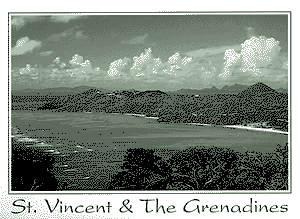
Up at 3 so started some pinhole night photos of the sky. My FamoCoquillettes with tomato-mackerel sauce turned out pretty well. There’s enough for another meal. Need to get some popcorn for the chickens
(perhaps) and then cooking oil… so may be not. But I will get into
town to buy a paper. Plan to work on the watercolors again today. Took
some larger images of the water with the Xacti camera for use as a web
icon and a printed postcard advertising the advance sale of the entire
suite of Carib Waters paintings: 50 double-sided watercolours for
$30,000 until Sept 30; $700 each thereafter. I’ll scan them and put the
files up on my website and Facebook (http://bbrace.net/webgallerywc/wc.html)
Met some people originally from Martinique on the beach. The happy dogs
were all barking at them of course. Curiously the female German Shepard
is quite protective of me: she sat right at my elbow when the strangers
approached, and barks at the billy goat when he bumps-me, and tried to
lick my swollen facial centipede bite. Went for my walk (almost) around
the island this morning before it got hot. The GS and the Lab-mix
followed me all the way; I had to wait for them to cool-off in the
Jerome Village lagoon at one point. I didn’t realize there were so many
dogs in town until we walked by…. More w/c work; have a few mores days
to wrap-up the suite of 101 double-sided paintings. Will ask about a
day trip to Mayreau but I’m guessing it’s ridiculously expensive —
probably the affluent Tobago Keys effect. Do tourists cause local prices
to rise? Thought about having a GIP coin minted to accompany the
coin/card edition. Would also serve as a good standalone promo item that
could be left anywhere to circulate. Boiled-up the last of the chow mein
noodles with the orange spicy pepper sauce. Wonder if they’d nake a good
(fat-free) snack when dried. Read that seemingly spent lithium batteries
can be revived a little by leaving them in the sun — I’m trying this
out. (Also by hitting them with a rock.) The chickens are upset and
pacing outside the door.
The trouble with Tao is its claims to indifference (irresponsible
“disengagement”) and selective acceptance of oppressive policy/regimes
(which are the real cause of the root dissatisfactions), to “avoid
harm.” I understand the attraction of such a last-resort doctrine but
it’s really not much different than rich corporate robber-barons hiding
their money offshore and retreating to private islands. It’s nearly
(tribal political) election time in SVG where the sale of passports (why
does anyone care?), VAT (why increase taxes during a recession?) and
timid socialism (yes, comrades; thieves, murderers and crooks: beat
around de bush) seem to be the only visible issues. I’d like to know
what happened to St Lucia; it’s often mentioned as a political scenario
to be avoided. Radio stations are deliberately reactionary and
bi-partisan but aggressive lawsuits against media are astonishing. My
brotha!. Eventually biblical-scripture muddies the minimal useful
dialogue. The chickens are understandably upset again this evening.
False prophets. Not hopeful.
Signs (painted lyrics) at Pebbles Jazz Club in St George, Grenada:
I WENT DOWN TO THE CROSSROAD – FELL DOWN ON MY KNEES
THEY CALL IT STORMY MONDAY, BUT TUESDAYS JUST AS BAD
ON THE SEVENTH HOUR OF THE SEVENTH DAY ON THE SEVENTH MONTH, THE SEVEN DOCTORS SAY HE WAS BORN FOR GOOD LUCK
I GAVE YOU A BRAND NEW FORD BUT YOU SAID “I WANT A CADILLAC” I BOUGHT YOU A HUNDRED DOLLAR DINNER & YOU SAID “THANKS FOR THE SNACK” I LET YOU LIVE IN MY PENTHOUSE – YOU SAID “IT’S JUST A SHACK” I GAVE YOU SEVEN CHILDREN AND NOW YOU WANNA GIVE THEM BACK
Ate all the cold and spicy chow mein noodles last night — very good as
a snack (not good dried.) Have finished-up the watercolour suite. A good
sunbathing activity. The sun and wind quickly dry deliberately shaped
puddles of color-wash. There are a couple I could ‘noodle’ around with a
little more but it all feels finished somehow. Need to buy a good set of
travel brushes, half-pans, ox gall, compartment box, and more w/c books.
Will see if I can do my walk without attracting the notice of the bully
dogs.
Took the Angelo watertaxi to Mayreau ($150EC not too bad considering
that he had make four trips — and he had lifejackets!) It’s the
smallest inhabited Grenadine Island with only 200 inhabitants, mostly
fishermen – felt a little tense and expensive. Apparently cruise ships
dump their passengers here, which would account for the big stacks of
locked-up lounge chairs on the beach. Everyone lives in the middle of
the island: something to do with the government acquiring what was a
private island and re-settling people while “Canadians” and a group of
lawyers from SV bought the rest. Righteous Robert’s brightly painted
Rasta-urant and the Catholic stone church on the hilltop with a great
view of the Cayes, were interesting to see. Electricity was introduced
in 2003. There is an elementary school, post office, a few grocery
stores, bars and medical clinic. Big HIV/AIDS sign. Apparently the local
water is risky.
My neck is still stiff from being slammed around in that little boat
yesterday. Didn’t wake-up until 6.
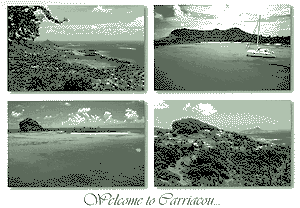
Thursday Feb 25: packing day in preparation for the journey back to
Grenada tomorrow morning. Charge the batteries and gadgetry. Empty the
fridge. Clean-up a little. Estimate power bill and pay Y. Dispose of the
disposables. Hand wash shirt and shorts and hang to dry overnight.
Shower in the evening. Text Bones a reminder and ask for a lifejacket if
possible. I think I’ll try sitting backwards and farther back in the
boat this time. Don’t know if I’ll bother with PSV backup tour or not. I
can call Angelo if need be, but he charges $150EC to PM.
Well, Bones finally showed-up but he first picked-up a little ‘package’
at another dock. He is a skilled boatman — a very smooth passage. I was
surprised and delighted to learn that Richard & Pam had leased (perhaps
questionable, according to E, beachfront land ($100EC/mo) and were
industriously building a modest hexagonal house of their own design. The
local children call it the “coin house,” in reference to Grenada’s
multi-sided coinage. I’m very impressed with what I’ve seen and it’s all
built visually and by hand. Thrilled to see how it all transpires and
integrates into the community. PM is certainly a tenser place to live…
I’d been back there for a few hours and the cops were on me… ^how long
have you been here; you’ve been here before; why are you taking
pictures?… (all those stories about locals remembering faces are
true)…But in truth a modestly strong swimmer could get to PSV from
PM… it’s that close. I noticed that the new VAT has dramatically
increased the price of groceries that I saw at Matthew’s — a major
player on the island. Apparently he contributed to this impressive
sounding community center above the primary school that was supposed to
provide internet access and library/media facilities to one-and-all. The
old-timers sit on LIME mobile store steps by the wharf to chat with
friends waiting for the ferry to arrive. The Osprey arrives at the dock
around noon and then mysteriously goes back out into the bay and
apparently anchors for lunch, returning at 3 p.m.
Staying at K’s Caribbean Cottage Club ($170US $440EC for 3 nights –
ouch!); very nice 2 bdrm apartment with high pitched ceilings, lots of
wood and louvered windows and doors. Making recordings from the porch at night. You can glimpse the sea over the palm trees in front. Bought some
tasty BBQ chicken last night ($3.50EC) from a lady down the street. Rum
‘n’ coke and plantain chips. This morning walked down to Grand Anse Bay
and beach then back here with some groceries (big bottle of Coke, dry
roasted peanuts, tonic water, and souvenir spice collection which I
should have purchased from the market in St George where they’d likely
be fresher and cheaper. Also wandered around town: library and museum
closed, Pebbles Jazz club with attached art gallery (closed), Scare Dem
World music shop (Mighty Sparrow CD copy $15EC), vegetable, fish, and
meat markets. Made a nice little film of a big LCD billboard. Walked
around Ft George (closed) taking 12hr photos of the walls. Back to the
apt again where I read some tourist publications. Thought about taking a
Sunsation tour on Sunday but unfortunately they’re not offering any that
day. “Tutti Frutti” Tour ($80US) : St George Stadium, Picturesque West
Coast, Concord Waterfall, Gouyave Nutmeg Processing Station, Carib’s
Leap, River antoine Rum Distillery, Pearls Airport (which I think is a
raceway), Grenville, Rainforest at Grand Etang Crater Lake. I could ask
the Crabman taxi for a similar tour but I think Katrina said he charges
$200US which be ok split between a few people but no one of the
semi-permanent guests here would want to go. So I might just visit the
two botanical gardens instead. Reading a Frank Zappa biography that was
in the apt. Phoned to confirm my flight home on Monday.
Signs (painted lyrics) at Pebbles Jazz Club in St George, Grenada:
HEY EVERYBODY, LET’S HAVE SOME FUN, YOU ONLY LIVE ONCE AND WHEN YOU’RE DEAD, YOU’RE DONE
IT DON’T MEAN A THING IF IT AIN’T GOT THAT SWING
BIRDS FLYING HIGH – YOU KNOW HOW I FEEL, SUN IN THE SKY – YOU KNOW HOW I FEEL, BREEZE DRIFTIN’ BY, YOU KNOW HOW I FEEL – I’M FEELING GOOD
WHEN SHE WALKS SHE’S LIKE A SAMBA THAT SWINGS SO COOL AND SWAYS SO GENTLE THAT WHEN SHE PASSES, EACH ONE SHE PASSES GOES “A-A-AH”
Nearly robbed – at least I can’t see anything missing – last night.
Someone used a length of stiff wire to try and hook things on a table
next to the window louvers. At first I thought they had stolen my PDA
case with wireless modem and SD card inside, but then I spotted where it
had dropped on the floor. (There appears to be wifi in the apt but I
haven’t the desire to try it out.) I actually considered such a remote
possibility before going to bed at 9, and considered moving my recording
equipment inside the locked bedroom, but finally just slid most
everything off to the far end of the table. There’s a locking gate and
barbed wire frost fence, some of the windows are barred and chained, or
nailed shut; there’s supposedly a watchman (big help), and a mastif-like
black dog. I wonder if it wasn’t the beatific smiling rasta kid (Tille)
that helps-out here — he came by to relay a message about the
Sunsations tour and furtively noticed my minidisc equipment set-up on
the balcony. I asked K about security/safety my first day and of
course she downplayed it, saying that once a guest had her handbag
grabbed but local people pounced on the thief. While trying
unsuccessfully lock a door, she told me that she was an Italian ex-pat
yoga instructor (with long blonde dreads), that wasn’t ‘very practical,’
so I’m thinking her employees may take advantage of their situation. The
former owner lived in this apartment, which would explain the security
fortifications. There are workers here as well adding some structures to
other buildings, but it must have been an inside job; no one else would
have had that specific intimate knowledge of building layout and have
likely previously crafted the wire-tool. Also other things outside:
books, laundry, cushions were not disturbed. The previous night I left a
lithium battery out to hold down some paper receipts. It was there as I
encountered the ‘maid’ hanging the laundry in the breezeway but gone
when I returned, the receipts had been ‘thoughtfully’ placed under a
book on another table. I’ll be leaving the lights and TV on all the time
today So not at all like Big Sand where you safely leave your screened
windows open all day/night. St George is quite Westernized and I imagine
is considered ‘progressive,’ attracting an affluent, comfort-seeking
tourist. Earthquake in Chlie, tsunami in Japan; alerts in Hawaii.
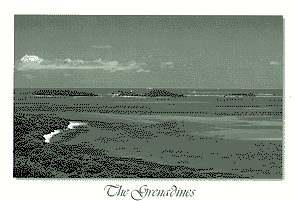
K talked me into going to some Grand Anse beach where we (her son and
young handsome boyfriend who seems to want to be a cop and surrogate
father), had an expensive and poor lunch. Left early for the airport
next morning where I repacked my slightly overweight luggage and the
security people tore apart my carry-on luggage, inspecting every item
and insisting that I go back_out and put some items (a bicycle-cable,
lock and 9V battery) in my checked-luggage. While I was out they stole
items from my carry-on bag!! I can’t recommend that anyone visit
Grenada; I’ll just say that Grenadinians are much different from
Vincentians. Finally flew home. Just click-on OK.
Bangladesh, which is currently engaged in a dispute with Myanmar over
border fencing, fears that Yangon may attack its St. Martin’s Island in the
Bay of Bengal. Bangladesh Rifles (BDR), which guards the land border, has
identified the St Martin’s Island as the “probable main target” of Myanmar
and has asked the government to immediately strengthen its defence by
constructing aircraft landing zones and concrete bunkers. This is contained
in a “strategic proposal” that came in the wake of constant military
build-up and intimidation by Myanmar. The St Martin’s Island, the only
coral island of the country and the main attraction for local and foreign
tourists for its panoramic beauty and pristine marine life, is under the
jurisdiction of the Bangladesh Coastguards. The island, which is located in
a mineral rich region in the Bay of Bengal, is 8 km west of Myanmar coast.
The BDR has submitted its proposal to the Ministry of Home Affairs, the
Prime Minister’s Office, the navy and air force headquarters and the
director general of Coastguards. It has also urged the government to
increase defence capability of land and sea borders to “repulse any
possible aggression by the neighbouring country”.
China has started the relocation of 330,000 residents to make way for a
canal bringing water from the south to the north of the country, in China’s
second-largest resettlement scheme. Families from Henan and Hubei provinces
are being moved to make way for a canal which will run from the Yangtze
River to Beijing. They are being moved to newly-built villages and will
receive an annual subsidy of around 88 US dollars. The scheme is part of an
expansion of the Danjiangkou reservoir. The government says it hopes to
have water flowing from the Yangtze and its tributaries to the arid north
part of the country by 2014. Around 1.3 million people have already been
relocated to make way for the Three Gorges Dam, which was completed last
year.
A high-profile coalition of artists — including the members of Pearl Jam,
R.E.M. and the Roots — demanded that the government release the names of
all the songs that were blasted since 2002 at prisoners for hours, even
days, on end, to try to coerce cooperation or as a method of punishment.
Dozens of musicians endorsed a Freedom of Information Act request filed by
the National Security Archive, a Washington-based independent research
institute, seeking the declassification of all records related to the use
of music in interrogation practices. The artists also launched a formal
protest of the use of music in conjunction with torture. “I think every
musician should be involved,” said Rosanne Cash. “It seems so obvious.
Music should never be used as torture.” The singer-songwriter (and daughter
of Johnny Cash) said she reacted with “absolute disgust” when she heard of
the practice. “It’s beyond the pale. It’s hard to even think about.” Other
musicians, including Trent Reznor of Nine Inch Nails and Tom Morello,
formerly of the band Rage Against the Machine, also expressed outrage. “The
fact that music I helped create was used in crimes against humanity sickens
me,” Morello said in a statement. “We need to end torture and close
Guantanamo now.”
Approximately 57 small islands scattered around southern Trenggalek
regency, East Java, are still unnamed. Their natural potentials have not
been identified as well. The islands are scattered, starting from Panggul
water to Prigi, Watulimo sub district. The small islands could yet be used
maximally. The procedure of island identification and the mapping of
natural potentials of the 57 islands are also very complicated. Permission
from the Local Affairs Department and recommendations from the provincial
government is required. Also, because island naming is overseen by the
international law, PBB must also approve it. Another challenge in the
identification of the islands is the different perceptions between
Trenggalek local government and Tulungagung regional government on some of
the islands located in the borderline between the two regions. The
anonymous islands have a considerable amount of swallow nests. Due to the
absence of budget to optimize the resources, the swallow nests are
reportedly often stolen.
Many “matuto” paintings, as a kind of scratches from the pre-historic rock
arts, were found in a number of villages which belong to Kaimana District,
Provinice of Papua Barat. Matuto is a shape of a half-man lizard and
believed as the ancestor of heroes. A lot of matuto paintings were found at
niche surfaces made as canvas for the artists of the pre-historic time in
several archaeological sites. Matuto motif belongs to an anthropomorphic
group with religious meaning representing the people`s ancestors living in
Kaimana in the pre-historic time. Besides matuto, the anthropomorphic group
also includes a palm-print motif which means a protective power to prevent
from evil things, and a human motif. Matuto paintings were found in the
sites of Omborecena, Memnemba, Memnemnambe and Tumberawasi located in
Maimai village. Whereas in Namatota village, matuto paintings were also
found in the sites of Werfora I, Werfora II, Werfora III and Werfora IV.
The other pre-historic paintings which were scratched at the niche surfaces
are in the motifs of lizard, fish, tortoise, crocodile, cuscus, snake, bird
and sea horse which belong to the fauna group. In the geometrical motif,
there are the pictures of sun, direction mark, rectangular and circle. The
pictures of man`s cultural objects include those on the shapes of boat,
boomerang, spear, rock axe, sago hammer and mask. Pre-historic men
scratched paintings on niche surfaces with natural color substance and
their works were called rock arts which served as media to express ideas or
thoughts concerning certain events. These archaeological relics are sort of
civilization from the ancestor`s community in Papua, and have enriched the
national culture.
A new World Food Programme (WFP) pilot project plans to use text messages
on mobile phones to distribute food vouchers to Iraqi refugees in Syria.
The United Nations announced the scheme this week and said it will target
1,000 Iraqi refugee families living in Damascus. Families will be provided
with a special SIM card to receive a 22 US dollar voucher every two months,
which can be exchanged for rice, wheat flour, lentils, chickpeas, oil,
canned fish, cheese and eggs at selected shops. The WFP explained that all
the 130,000 Iraqi refugees currently receiving food aid in Syria already
have mobile phones. The project will initially run for four months, but
might be extended depending on its success.
Members of the protective services routinely muzzle sweep each other, along
with civilians. One IATF officer shot himself in the toe while on patrol in
a densely populated area of the capital city. These armed persons are a
potential menace. Another member of the public was ‘accidentally’ shot by a
cop while holding his five-year-old daughter on the roadside, while waiting
to cross the street. This occurred at a busy intersection, at Charlotte and
Duke Streets, in Port of Spain. Criminals arriving by, and leaving in small
fishing boats, have been targeting sea-bathers at Chagville Beach in
Chaguaramas. What makes this particularly frustrating is that this beach is
across the street from the TT Defense Force Headquarters. The TTDF has a
proud history of serving this nation, so it’s ironic that these violent
crimes occur within line-of-sight of their HQ. One may argue that the
classical role of a defence force is not law enforcement. True; but if that
is the case in our country, then why do we have police/army “joint
patrols”? Surely TTDF Chief of Defence Staff Brigadier Edmund Dillon is
taking this as a personal assault on the reputation of the TTDF. After all,
one of it’s stated responsibilities is, “cooperate with and assist the
civil power in maintaining law and order.” Additionally, every Chief of
Defence Staff has included these words (in one form or another) in their
speeches: “The Trinidad and Tobago Defence Force is fully prepared to
defend the sovereign good of our nation from all enemies, foreign or
domestic.” How about starting with enemies across the street? The primary
agency charged with the responsibility of policing the Western peninsula is
the Chaguaramas Development Authority Police. Inspector Abdul Singh, the
highest ranking officer of the CDA police, has many challenges, including
acute shortages of personnel, arms, ammunition and vehicles.
In Ecuador, the Shuar are blocking highways to defend their hunting
grounds. In Chile, the Mapuche are occupying ranches to pressure for land,
schools and clinics. In Bolivia, a new constitution gives the country’s 36
indigenous peoples the right to self-rule. All over Latin America, and
especially in the Andes, a political awakening is emboldening Indians who
have lived mostly as second-class citizens since the Spanish conquest. Much
of it is the result of better education and communication, especially as
the Internet allows native leaders in far-flung villages to share ideas and
strategies across international boundaries. But much is born of necessity:
Latin American nations are embarking on an unprecedented resource hunt,
moving in on land that Indians consider their own — and whose pristine
character is key to their survival. “The Indian movement has arisen because
the government doesn’t respect our territories, our resources, our Amazon,”
says Romulo Acachu, president of the Shuar people, flanked by warriors
carrying wooden spears and with black warpaint smeared on their faces. A
month ago, the Shuar put up barbed-wire roadblocks on highway bridges in
Ecuador’s southeastern jungles to protest legislation that would allow
mines on Indian lands without their prior consent, and put water under
state control. An Indian schoolteacher was killed in a battle with riot
police. “If there are 1,000 dead they will be good deaths,” says another
Shuar leader, Rafael Pandam. The Shuar won, at least this round. A week
after the killing, President Rafael Correa received about 100 Indian
leaders at the presidential palace and agreed to reconsider the laws.
Correa had earlier called the Indians “infantile” for their insistence on
being consulted over mining concessions. But he didn’t need to be reminded
that natives — a third of the population — have become an indispensible
constituent and helped topple an Ecuadorean government in 2000.
Mouth-watering Indian snacks like the spicy chaat, masala dosas and chicken
rolls are increasingly becoming popular in Bangladesh where the taste for
western fast food has been holding sway till now. A number of trendy
restaurants in metropolis Dhaka and other cities are now introducing the
snacks in their menu in a bid to attract not only the local food buffs but
international visitors as well. “No longer satisfied with hamburgers, hot
dogs and fries, Bangladeshi eating out habits, never to be left behind, has
also caught on to the trend. Indian items are fast replacing the European
menu as the favoured grab-and-go food of choice, not just because of the
taste but its healthier make-up, and has spread around the world. Popular
restaurants like ‘Dhaba’ are now selling chaat items like bhel puri and the
golgappa. It also has dahi papri, papri chaat, aloo chaat and aloo tikki.
These mouth-watering treats are all served up to you with a smile.
The Weather Office has warned the country to prepare for the cyclone season
in coming months. In a media advisory, the office said the tropical cyclone
season is between November and April. However, the month of January has
been predicted as the peak month for cyclone to hit. Cyclone can also occur
during other months before November and after April however, with lower
risks. On average, one or two cyclone forms in Solomon Islands each year.
Although, El Nino-Southern Oscillation (ENSO) is a significant contributor
to the year to year variability in tropical cyclone activity in the South
Pacific Ocean, it does not have great influence on the cyclone frequency
occurring here. With the typical El Nino conditions continue to persist in
the Tropical Pacific the outlook for Tropical Cyclone activity in the
Solomon Islands during November 2009 to April 2010 is likely to be average
due to the weak El Nino condition. In light of a likely cyclone occurrence,
local communities have been reminded to remain alert and prepared for any
cyclone hit during this season.
Bangladesh is set to officially release three flood-tolerant rice varieties
that would help farmers prevent up to a million tonnes of annual crop loss
caused by flash floods. These rice varieties with submergence-tolerant
gene, known as Sub1, can withstand two weeks of complete submergence. The
Seed Certification Agency has been asked to release the three
submergence-tolerant varieties, Swarna-Sub1, BR-11-Sub1, and
BR-11-Recombinant-Sub1. The Bill and Melinda Gates Foundation supports the
project. The flood-tolerant versions of the high-yielding varieties (HYVs),
popular with farmers and consumers, that are grown over huge areas across
Bangladesh are effectively identical to their susceptible counterparts but
those recover after severe flooding to yield well. The Sub1 varieties
withstood submergence quite well during this year’s flash floods in
Jamalpur’s Dewanganj, Kurigram’s Kachir Char, Mymensingh’s Dhobaura and
Sylhet’s Golapganj. The Sub1 varieties have been tested in six BRRI fields
and nine farmers’ fields over the last couple of years and all results show
positive signs.
Trinidad and Tobago joined millions of Hindus around the world to celebrate
Divali, also known as Diwali, Deepavali or Dipavali. Thousands of Hindus
and non-Hindus lined their homes and streets with deyas, a clay vessel
holding coconut oil and a wick. The illuminated streets, a reminder of why
Divali is called the festival of lights, are reminiscent of good triumphing
over evil. The deya is also meant to raise awareness in the believer of his
or her own inner light. The streets of many parts of Trinidad and Tobago
where Hindus make up the majority were beautifully lit. Curved bamboo
strips, walls and fences were used as stands for the deyas. A growing trend
in Trinidad and Tobago is also to see non-Hindus lighting deyas and placing
them on their walls and banisters. Roti shops, caterers and other places
selling Indo-Caribbean food also report a sharp incline in sales around
this time, as enthusiasm about local Indian food spurts, primarily among
persons without home access to the popular dishes. On these islands where
many celebrate everything, every last trimester the local celebratory
spirit ascends. The muslim celebration Eid-ul-Fitr, the Hindu festival
Divali, and the Christian season of Christmas often ensue in rapid
succession. Many who put up lights for Divali will leave up their electric
lights until the end of Christmas and the start of Carnival. In some
regards, it could be argued that the cultural calendar of Trinidad and
Tobago begins with either Eid or Divali – whichever comes first – because
thereafter one season flows into the next. As a result, ethnic groups in
Trinidad and Tobago demonstrate high levels of religious tolerance,
cultural cohabitation and racial harmony. The world should take note.
The recent conflict in the Pakistani region of South Waziristan has already
displaced at least 160,000 people and could rise to 260,000 in the next few
weeks. Local aid workers have registered 160,000 people in six IDP camps
around Dera Ismail Khan, a town on the southern fringe of the tribal area.
They expect a further 100,000 people to arrive in the next few weeks. The
total would amount to just over half of the area’s 500,000 population.
Fighting in South Waziristan has escalated since the government launched a
renewed military offensive against the Taliban. The move follows attacks by
Taliban militants across Pakistan that left at least 175 dead, including a
suicide bomb that exploded at Islamabad University, killing four people.
The musicians’ announcement was coordinated with the recent call by
veterans and retired Army generals to shut Guantanamo. It is part of a
renewed effort to pressure President Obama to keep his promise to close the
prison in Cuba in his first year in office. A White House spokesman said
music is no longer used as an instrument of torture, part of a shift in
policy on interrogations that Obama made on his second full day in office.
The president also formed an interagency group, called High-Value Detainee
Interrogation Group, to examine the techniques used during questioning, but
a White House spokesman said that the new group has yet to be fully
constituted. “The president banned the use of ‘enhanced interrogation
techniques,’ and issued an executive order that established that
interrogations must be consistent with the techniques in the Army Field
Manual and the Geneva Conventions,” a White House official said. “Sound at
a certain level creates sensory overload and breaks down subjectivity and
can bring about a regression to infantile behavior. Its effectiveness
depends on the constancy of the sound, not the qualities of the music.
Played at a certain volume, it simply prevents people from thinking.
The CIA Playlist includes:
AC/DC Aerosmith Barney theme song (By Bob Singleton) The Bee Gees Britney
Spears Bruce Springsteen Christina Aguilera David Gray Deicide Don McClean
Dope Dr. Dre Drowning Pool Eminem Hed P.E. James Taylor Limp Bizkit Marilyn
Manson Matchbox Twenty Meatloaf Meow mix jingle Metallica Neil Diamond Nine
Inch Nails Pink Prince Queen Rage against the Machine Red Hot Chili Peppers
Redman Saliva Sesame street theme music (By Christopher Cerf) Stanley
Brothers The Star Spangled Banner Tupac Shakur
Pins Depicting Muhammad Picture Circulating: The pins also incribe an
Arabian writing that reads ‘Prophet Muhammad SAW’. After receiving report
on the circulation of the pins, East Makassar police immediately arrest the
pin owners. According to East Makassar Police Head, his team has caught two
owners of the Prophet pin. “They are Bahanda, the resident of Samata sub
district, Gowa regency, and Anto, the resident of Tonro, Makassar.” From
Bahanda’s house, the police confiscated 5 pins and stickers with the
drawing of Prophet Muhammad printed on. The police also seized a laptop.
“Currently, the focus of the investigation is the ownership of the pins
which have been circulating in Makassar during the past two days. The two
suspects are still undergoing inquisitions at the police headquarters. “For
now, no charges have been laid, including the accusation of religion
outrage.”
The figures by the Tribunal Supremo de Elecciones (TSE) reveals that more
Nicaraguan men are more likely to marry Costa Rican women than Nicaraguan
women to marry Costa Rican men when the arrive in Costa Rica, with a total
of 12.515 Nicaraguan men marrying “ticas”, while only 934 Nicaraguan women
married “ticos” between 1950 and 2009. Nicaraguan men arrive in Costa Rica
single and without commitment, while the women leave behind children and a
significant other which to stay faithful to. Perhaps the reason is that
more Nicaraguan men come to Costa Rican than Nicaraguan women, explaining
the difference in the numbers. The man is looking to settle here, is more
irresponsible and not attached to theri children back in Nicaragua. The
woman are transitory, leaving children and partner behind with an eye to
returning. They marry for increased sexual potency, protection from
immigration and to have a Costa Rican child. One man said Costa Rican women
are pretty, while other say they don’t like Costa Rican woman because they
are “too liberal”, “like to go out a lot” and “are bossy”.
For the second year in a row, world grain production rose, with farmers
producing some 2.3 billion tons. The record harvest was up more than 7
percent and caps a decade in which only half the years registered gains.
Today, only 150 crops are cultivated, a sharp drop from the 10,000 used
over time, and three grains–maize, rice, and wheat–combined with potatoes
provide more than 50 percent of human energy needs.
At least two people died and 100 people were injured when Bangladesh police
fired rubber bullets at thousands of garment factory workers rioting over
unpaid wages. The two people were killed after around 15,000 workers began
hurling stones and rocks, prompting officers to retaliate, in the worst
industrial violence to shake Bangladesh as it struggles to cope with the
fallout from the global recession. The protesters, who worked for
Bangladeshi-owned Nippon Garments, were demanding three months’ back pay
from owners who had shut down the factory, blaming a lack of orders. The
law-enforcers had to fire rubber bullets from shotguns to disperse the
workers who hurled stones and bricks at the cops; two people had died. At
least 100 workers and a number of cops were hurt in the clashes in the
Tongi Industrial Area, 40 kilometres (25 miles) north of Dhaka. Nine of the
injured were admitted to Dhaka Medical College Hospital « with wounds
caused by live ammunition and some are in serious condition. The cops said
they used only rubber bullets to quell the unrest. The angry workers became
unruly and violent this morning. They threw up barricades on the roads and
suddenly attacked police. The workers also damaged vehicles, torching some,
and blockaded road links between Bangladesh’s northern districts and Dhaka.
The clashes were the most severe since the global downturn began to affect
Bangladeshi apparel factories, which accounted for 80 percent of the
country’s 15.56 billion dollars worth of exports in the last financial
year. Some 50,000 workers protesting wage cuts and unpaid salaries clashed
with police, leaving scores injured. The global slowdown had forced many
factories in the country to lay off workers or shut down. Western retailers
who are our top buyers have cut orders and squeezed prices. The big
factories have somehow coped, but most of the small- and medium-sized
factories are facing very tough times. Overseas shipments fell by three
percent. Unions said factories have cut wages to compete for orders with
other apparel-producers, such as Vietnam, China and India.The owners of
Nippon Garments were due to pay the wages and had asked employees to
collect their money. But they shut down the factory in the night and sent
police to guard the factory. The workers became angry when they saw the
owners had left without paying the salaries. Forty percent of Bangladesh’s
industrial workforce is employed in the garment sector.
Indians make up one in 10 of Latin America’s half-billion inhabitants. In
some parts of the Andes and Guatemala, they are far more numerous. Yet they
remain much poorer and less educated than the general population. About 80
percent live on less than $2 a day — a poverty rate double that of the
general population — while some 40 percent lack access to health care. The
threats to Indian land have grown in recent years. With shrinking global
oil reserves and growing demands for minerals and timber, oil and mining
concerns are joining loggers in encroaching on traditional Indian lands.
Indians have been progressively losing control and ownership of natural
resources on their lands. The situation isn’t very encouraging. Hence the
revolt rippling up and down the Andes. In Peru, south of the Shuar’s lands,
the government has divided more than 70 percent of the Amazon into oil
exploration blocks and has begun selling concessions. Fearing contamination
of their hunting and fishing grounds, Indians last year began mounting
sporadic road and river blockades. Riot police opened fire on Indians at a
road blockade outside the town of Bagua, where jungle meets Andean
foothills. At least 33 people were killed, most of them police. The Indians
were unapologetic for resisting. “Almost everything we have comes from the
jungle,” says one of the protesters, a wiry elementary school teacher from
the Awajun tribe named Gabriel Apikai. “The leaves, and wood and vines with
which we build our homes. The water from the streams. The animals we eat.
That is why we are so worried.” Farther south along the world’s longest
mountain chain, Chilean police are protecting 34 ranches and logging
compounds that Mapuche Indians have targeted for occupations or sabotage.
The Mapuche, who dominated Chile before the Spanish conquest, now account
for less than 10 percent of its people and hold some 5 percent of its land
— among the least fertile. Mapuche activists agitating for title to more
lands and greater access to education and health care stepped up civil
disobedience this year. Riot police mounting an eviction killed one
Mapuche, and eight were injured. “If the government and the political class
doesn’t listen to our demands the situation will get a lot more difficult,”
Mapuche leader Jose Santos Millao said. He rejects as a “smoke screen”
President’s creation of an Indian Affairs Ministry.
The crime upsurge cannot be ignored despite the absolutely gracious
approach of the British couple who sent a letter of assurance to the
Minister of Tourism and to the THA about their undying love and affection
for the island and its people even after the vicious attack they suffered.
The killing and burying of a German, whose body was found in a shallow
grave, is the latest setback. Bringing the number of murders on the island
to 11, this latest incident also flies in the face of the attempts by the
police to demonstrate that they have the situation well under control.
After every such major crime, the police pledge to take stronger measures,
to increase patrols and to maintain a more visible presence in what they
themselves identify as vulnerable areas. The discovery of the body of the
German at what was his home in Bacolet Crescent does indeed present a new
feature to the murder picture in Tobago. It suggests that criminals are
employing even more grisly methods of perpetrating these offences, further
fouling the environment in which all concerned must respond. Sensing that
he was indeed in some danger, with death threats having been issued to him,
the man was reportedly in the process of making arrangements to leave
Tobago for good. That he was a German-the nationality that has had such a
long and deeply ingrained association with Tobago-is bound to send further
shock waves through that community many of whom have shared their hitherto
wonderful experiences with others who have been making regular trips to
Tobago. Much work is going to be needed to continue the repair job on the
island’s image occasioned by this and the other serious offences. But the
multiplier effect of another gruesome incident such as this on the island’s
profile cannot be underestimated, no matter what the manner of the media
coverage may be, no matter what means may be employed to colour the
presentation.
Try telling Brother Jerry Smith that the recession in America has ended. As
scores of people queued up at the soup kitchen which the Capuchin friar
helps run in Detroit, the celebrations on Wall Street in New York seemed
from another world. The hungry and needy come from miles around to get a
free healthy meal. Though the East Detroit neighbourhood the soup kitchen
serves has had it tough for decades, the recession has seen almost any hope
for anyone getting a job evaporate. Neither is there any sign that jobs
might come back soon. Some in the past have had jobs here, but now there is
nothing available to people. Nothing at all. The hungry, the homeless and
the poor crowded around tables. Many were by themselves, but some were
families with young children. None had jobs. Indeed, the soup kitchen
itself is now starting to dip into its savings to cope with a drying up of
desperately needed donations. This is an area where times are so tough that
the soup kitchen is a major employer for the neighbourhood, keeping its own
staff out of poverty. Officially, America is on the up. The economy grew by
3.5% in the past quarter. On Wall Street, stocks are rising again. The
banks – rescued wholesale by taxpayers’ money last year – are posting
billions of dollars of profits. Thousands of bankers and financiers are
wetting their lips at the prospect of enormous bonuses, often matching or
exceeding those of pre-crash times. The financial sector is lobbying
successfully to fight government attempts to regulate it. The wealthy are
beginning to snap up property again, pushing prices up. In New York’s
fashionable West Village a senior banker recently splurged $10m on a single
apartment, sending shivers of delight through the city’s property brokers.
But for tens of millions of Americans such things seem irrelevant. Across
the country lay-offs are continuing. Indeed, jobless rates are expected to
rise. Unemployment in America stands at 9.8%. But that headline figure,
massaged by bureaucrats, does not include many categories of the jobless.
Another, broader official measure, which includes those such as the
long-term jobless who have given up job-seeking and workers who can only
find piecemeal part-time work, tells another story. That figure stands at
17%.
Darshona Sub1 at Darshona remained unharmed despite being completely
submerged for nine to 16 days this year. 65 percent of farmers cultivate
BR-11 during aman season, which is susceptible to flash floods or rainwater
over 10 days. So the Sub1 varieties now hold the potential to become a good
replacement for BR-11. There are four different Sub1 varieties, IR-64-
Sub1, Samba Mahsuri-Sub1, BR-11-Sub1, and Swarna-Sub1, at the Darshona
trial site. Of these four, the former two are relatively shorter-duration
rice while the later two takes a long time to harvest. The new varieties
were made possible following the identification of a single gene that is
responsible for most of the submergence tolerance. The gene is found in a
low-yielding traditional Indian rice variety known to withstand floods. The
potential for impact is huge. In Bangladesh, for example, 20 percent of the
rice land is flood prone and the country typically suffers several major
floods each year. Submergence-tolerant varieties could make major inroads
into Bangladesh’s annual rice shortfall and substantially reduce its import
needs. As water inundates rice fields, Sub1 gene helps rice plants remain
‘metabolically inert’ for up to two weeks; thereby, keeping the plants
unaffected. But if the water remain stagnant for a longer duration, it will
not be possible for the crop to withstand.” Farmers would be benefited if
the submergence tolerant rice varieties are released soon. The Philippines
released its first submergence-tolerant rice variety, Submarino 1,
recently.
They form the single biggest mass of refugees today, and they face an
uncertain fate as a factor in a geopolitical game involving two Asian
giants and allied players. For the about 400,000 fugitives from tiny Sri
Lanka’s Tamil-speaking areas of less than 18,000 square kilometers
together, the outlook has only become more unsettling. The tide of Tamil
refugees from the island-state’s northern and eastern provinces represents
a twin issue. About 100,000 of them are inmates of rather inhospitable
refugee camps in India’s southern State of Tamilnadu. They have been
languishing there for varying lengths of time, with the influx starting way
back in 1984. The population in the camps includes a generation of Sri
Lankan Tamils who have known no home but India but are not made to feel
quite at home in the country. The rest – as many as 300,000 – have been
held in camps behind barbed wires as internally displaced persons (IDPs) in
the war-ravaged parts of Sri Lanka since Colombo declared total victory
over Tamil rebels seeking a separate state. The inmates have been told to
be prepared to stay put for a period of one to three years. The population
of these camps consists of divided families, with mothers looking for
separated children and women for lost husbands. The plight of these
uprooted people of both categories poses a humanitarian problem of huge
proportions. That, however, would not appear to be how it is viewed in
quarters which matter in India and could make a difference in the
increasing distress of the displaced. New Delhi is under pressure to look
upon the tragedy, if not as a trump card, at least as a useful lever in the
Indian Ocean region where its influence is seen to be under threat from
China with Pakistan in tow. The debate rages in the media over the role
India should play in this perspective, even as the refugees await an
aggravation of their conditions in the camps. The north-eastern monsoon,
which brings most of the rains for this region for about three months until
December, is round the corner. The wet season threatens to prove a time of
terrible woes, particularly for the IDPs in their tarpaulin tents in
overcrowded camps. Unless people are moved from these areas, … an
inundation of water … will make it impossible to live…. The latrines
will overflow, water supplies will be unusable and access by wheeled
vehicles impossible. It will be pretty unbearable. More intolerable to some
security analysts will be India’s failure to use this fresh opportunity to
counter the influence of China and allies allowed to grow in its own
backyard over the past two decades. India has had its share of refugee
problems, but the spillover from Sri Lanka’s civil war falls into a special
category. The most politicized of the problems has been Bangladeshi
immigrants, estimated at 10 million (against the country’s population of
about 1.15 billion). India’s far right has always called them
“infiltrators” and sought to fuel pseudo-religious hatred against them as
Islamist fifth columnists. But this has remained an internal political
issue, with rather poor returns for its inventors.
The Seventh Summit of the ALBA, the Venezuela-led trade and economic bloc,
ended with a decision to implement a single currency for transactions among
member states. The leaders of Antigua and Barbuda, Dominica and St Vincent
and the Grenadines were among those who approved the Single Regional
Payment Compensation System (SUCRE). A multidisciplinary team from the ALBA
nations will begin technical operations for its implementation. However, it
is not yet clear how the introduction of the SUCRE will impact the
governments in St John’s, Roseau and Kingstown, since all three are members
of the Eastern Caribbean Currency Union that uses the EC dollar as its
common currency. The meeting also signed a special resolution condemning
the Honduras coup. The text demands the immediate reinstatement of Jose
Manuel Zelaya, who was ousted in a military coup. Zelaya sneaked back into
the Central American country and has been holding negotiations with the
newly-installed government on the way forward. Antigua and Barbuda,
Dominica and St Vincent and the Grenadines are the only Caribbean Community
countries that are also members the bloc that was formed in 2004 as an
alternative proposal to the Free Trade Area of the Americas.
Actions and events are planned in every Pacific Island nation for the 350
International Day of Climate Action. In the last 24 hours, events from the
Federated States of Micronesia and Kiribati have been registered with
www.350.org, completing the entire list of Pacific countries. Pacific
communities, many of whom are already affected by climate change, are
uniting to create actions that will raise awareness of impacts in the
Pacific. Each country’s call for action on climate change will be broadcast
through a global network, including on a huge screen in Times Square, New
York. In Kiribati, the 350 action involves over 2000 students and the
President, Anote Tong, in a beach clean up. In FSM, 350 coconut trees are
being planted after a celebration of the use of coconuts in traditional
society. Inhabitants of Cartaret Island will be some of the first people in
the world to be displaced by climate change. The 350 action will be located
at their proposed relocation site to highlight the massive implications of
climate change on their future. Cartaret Islanders will be transported by
boat in a flotilla to the relocation site where church gongs will ring 350
times and 350 mangrove seedlings will be planted. There will also be live
contemporary and traditional song and dance performances. Many of the
Pacific events involve peoples aggregating in traditional dress, and
performances of traditional song and dance. In Fiji, the Econesians are
staging a giant procession in Suva with song, dance, poetry and
entertainment. The Pacific Council of Churches is organising lalis
(traditional wooden gongs) 350 times to show their support for a safe
climate future. In the Solomon Islands a public march will culminate with
traditional Kastom dance and music in the ‘Cultural Village’. Traditional
song and dance will also be a major part of events in Papua New Guinea.
Ten men who belonged to the same soccer team were slain execution-style
after being abducted in a crime that could be the work of warring factions
in neighboring Colombia. Venezuelan troops stepped up security patrols in
the area near the Colombian border after the bodies of 10 men, most of them
Colombians, were found in multiple spots in western Tachira state. The
victims were among a group of 12 men who were kidnapped from a field where
they were playing soccer. The victims’ relatives reported the abduction of
10 Colombians, a Peruvian and a Venezuelan. The kidnappers, described as
armed men dressed in black, were thought to have called out the names of
the team’s members one by one before taking them away in vehicles. The
killings occurred near a porous border where Colombian rebels, paramilitary
fighters and drug smugglers are often able to move about with ease.
Venezuelan officials also have struggled in recent years with frequent
kidnappings and murders blamed on common criminals in various parts of the
country. The motive behind the latest slayings remains unclear. The single
known survivor, 19-year-old Manuel Cortez of Colombia, was shot in the
neck, said Orlando Lopez, one of his brothers. Lopez said that his brother
didn’t know his abductors. “They had them tied up for 14 days in the sun,”
Lopez said. “They tied them up to some trees, with chains on their necks
and with their hands locked up.” Lopez said his brother recalled the men
saying the hostages “didn’t have anything to do with it but that they were
going to kill them because they had seen their faces.” As for Cortez, “they
put him on his knees and they shot him,” Lopez said by phone from the
military hospital in Caracas where his brother was moved after being afraid
for his safety at a hospital in San Cristobal in the border region. A
stranger arrived at the first hospital asking to see Cortez and was
detained by authorities, Lopez said. “We don’t know what group” was behind
the killings, Lopez said. A list of names released by Venezuelan
authorities showed the victims ranged in age from 17 to 38, and several
were from the Colombian town of Bucaramanga, about 90 kilometers (55 miles)
from the border. Investigators suspect the bloodshed may be tied to a
confrontation between irregular groups as part of the Colombian conflict.
Venezuelan troops in the area had been ordered to “act forcefully” against
any armed Colombian group. Colombian officials in the past have accused
Venezuela of allowing leftist rebels to take refuge across the border.
Colombian President Alvaro Uribe condemned the killings and said they “show
that terrorism is international, that it has no borders.” He offered help
in the investigation and expressed confidence Venezuelan authorities will
act promptly to “take those terrorists to jail.” Relations have been tense
recently between Venezuelan President Hugo Chavez and Uribe’s U.S.-allied
government. Colombian officials have been critical of Venezuela’s efforts
to police its territory and reduce the flow of Colombian cocaine. Venezuela
charges Colombia and the U.S. are trying to use the drug issue to unfairly
discredit Chavez’s government.
A demon worshipper killed four members of his family before killing himself
on remote Misima Island in Papua New Guinea’s Milne Bay province. Milne Bay
police described the gruesome murder-suicide on October 10 as a massacre on
Misima, an island 200km east of mainland PNG. The killer was said to be a
demon worshipper who believed in a black Jesus and worshipped on
mountaintops before dawn. Rodney Sinod, from Eaus village on the south
coast of Misima Island, had on numerous occasions told his family that he
was going to kill them so the world would be free. Police reports indicated
that on the fateful morning, after his usual worship on a mountain, Sinod
returned to the family home and, without warning, attacked his father with
an axe. The victim, who was feeding chickens outside, died instantly. Sinod
then ran past his shocked mother into the house where his niece and nephew,
aged two and five years, were playing and killed them with the axe, before
mowing down his sister-in-law. Sinod later turned on his 17-year-old niece,
who had just finished grade 10 at Misima High School a day earlier and had
come home to spend the holidays with her family. Sinod chopped off part of
the teenagers lower left hand with the axe and struck her on the head. The
girl survived the attack and is recovering from her wounds at the Misima
district hospital. Sinod then ran to a mountain where he stabbed himself in
the chest with a knife.At least six villages were engaged in such
activities and reported that even a police officer had established a church
on the island with similar beliefs. Bizarre cults spring up frequently in
PNG. Police in Morobe province were hunting a cult leader who was coercing
followers to take part in public sex with promises of a bumper banana
harvest.
The Government Accountability Office likes to point its finger at
Luxembourg and the Cayman Islands for sheltering tax cheats. But according
to the U.K.-based Tax Justice Network, the United States is the biggest tax
shelter of ’em all, thanks to the great state of Delaware. Delaware, says
the Tax Justice Network, is “the most secretive financial jurisdiction in
the world.” That’s based on an analysis of 60 financial jurisdictions
according to level of secrecy and cooperation with foreign tax authorities.
Luxembourg comes in second, followed by the Switzerland, the Cayman
Islands, and the United Kingdom. Here are some fun facts about Delaware: *
According to the Delaware Secretary of State’s office their operating
budget was $12 million in 2007 and they made $24 million in the fees for
expedited incorporation filings alone. * There are currently some 695,000
active entities registered in Delaware, including 50 percent of the
corporations publically traded on the U.S. stock exchange. * New business
formations in Delaware are currently running at about 130,000 per annum. *
The growth of private individual deposits by non-residents was most robust
in the United States outranking other popular financial jurisdictions such
as the Cayman Islands, United Kingdom, and Luxembourg with total
non-resident deposits equalling $2.6 trillion in 2007. Nicole Tichon of
U.S. PIRG, probably the foremost homegrown tax-haven basher, said the
United States needs to get its tax act together. “If the U.S. wants to be
taken seriously by the international community and try to get their
cooperation, then we’ve got to crack down on what’s going on here at home.
We can’t have it both ways,” said Tichon. “Bank secrecy breeds the same
problems, the same criminal behavior, and puts up the same roadblocks to
law enforcement regardless of where it occurs. As long as the U.S.
government looks the other way, it diminishes our credibility on this
issue.” The Obama administration talked a good game at first about clamping
down on U.S. corporations that abuse tax shelters, but the administration
has since waffled.
Streaks of brilliant colors — red, purple, yellow, blue, green — are
splashed across the trunk of this eucalyptus, which also goes by the name
of rainbow eucalyptus. The Mindanao gum is one of the few non-Australian
eucalypti. It is native to tropical rainforests in the Philippines,
Indonesia and Papua New Guinea and named for the Philippine island of
Mindanao. As such it likes regular water and cannot take drought. That and
the usual eucalyptus ills make it unlikely for it to be planted much
anymore, but its colorful decorations make it a prized specimen where it
does occur. Gum The tree is grown in tropical areas for pulpwood production
for paper and harvested at an early age. Sometimes it is allowed to develop
for construction lumber, but the wood is only moderately strong and not
durable. The Mindanao gum is a fast-growing, rather open, erect evergreen
tree that may reach a height of 75 to 200 feet and a width of 30 to 75
feet. The smooth bark peels off to display the bright colors underneath.
The oval, 6-inch-by-3-inch leaves are bright green. They contain only a
little aromatic oil. The tree may bloom when it is 2 years old. Flowers are
clustered together and not very conspicuous. When in bud the white to pale
yellow stamens that give blooming flowers a fluffy look are hidden in a
covered cap, known as an operculum. The stamens push this cap off at
flowering. The genus name, based on the Greek eu kalyptos, or well-covered,
refers to this hidden quality. Woody cone-shaped capsules appear after
flowering. The Mindanao gum will take a wide variety of soils, but likes
full sun. It is frost hardy down to 24 degrees Fahrenheit. Just like other
eucalyptus trees, it is susceptible to aphid-like psyllids and borers. The
genus Eucalyptus was named by the 18th century French botanist Charles
Louis l’Heritier. The tree is part of the myrtle family, or Myrtaceae.
Nowhere is Indian power so evident as Bolivia, which elected its first
indigenous president, Evo Morales, in 2005. Morales dissolved the Ministry
of Indigenous Affairs and Original Peoples, calling it racist in a country
where more than three in five people are aboriginals. Voters approved a
constitution that creates a “plurinational” state and accords Bolivia’s
natives sovereign status. Time-worn models of aboriginal government,
community justice and even traditional healing are now legally on equal
footing with modern law and science. In the capital of La Paz, “cholitas” —
Indian women in traditional bowler hats and embroidered shawls — now
regularly anchor TV newscasts. “Miss Cholita” beauty pageants are in vogue
and native hip-hop stars headline at nightclubs. At the presidential
palace, Morales — a former Aymara coca farmer who knew hunger as a child —
makes a point of lunching periodically with the lowliest of palace guards.
Morales is ensuring that profits from natural gas and mineral extraction
are distributed equitably and that water — whose privatization in the city
of Cochabamba spurred an uprising in 2000 — is never again privatized. He’s
also pushing to make electrical utilities public. Morales has founded three
indigenous universities, formalized quotas for Indians in the military and
created a special school for aspiring diplomats with native backgrounds.
And he is promoting a campaign to demand that all public servants be fluent
in at least one native tongue. “There is no way to return to the past,”
says Waskar Ari, an Aymara who changed his name to Juan in the 1970s so he
would be accepted to a private high school in La Paz. Now a University of
Nebraska professor, Ari likens his country’s “rebirth” to the casting off
of apartheid on another continent two decades ago. “Finally,” he says
proudly, “Bolivia is no longer the South Africa of Latin America.”
The warlords that the USA champions in Afghanistan are as venal, as opposed
to the rights of women and basic democratic freedoms, and as heavily
involved in opium trafficking as the Taliban. The moral lines we draw
between us and our adversaries are fictional. The uplifting narratives used
to justify the war in Afghanistan are pathetic attempts to redeem acts of
senseless brutality. War cannot be waged to instill any virtue, including
democracy or the liberation of women. War always empowers those who have a
penchant for violence and access to weapons. War turns the moral order
upside down and abolishes all discussions of human rights. War banishes the
just and the decent to the margins of society. And the weapons of war do
not separate the innocent and the damned. An aerial drone is our version of
an improvised explosive device. An iron fragmentation bomb is our answer to
a suicide bomb. A burst from a belt-fed machine gun causes the same terror
and bloodshed among civilians no matter who pulls the trigger. We need to
tear the mask off of the fundamentalist warlords who after the tragedy of
9/11 replaced the Taliban. They used the mask of democracy to take power.
They continue this deception. These warlords are mentally the same as the
Taliban. The only change is physical. These warlords during the civil war
in Afghanistan from 1992 to 1996 killed 65,000 innocent people. They have
committed human rights violations, like the Taliban, against women and many
others. In eight years less than 2,000 Talib have been killed and more than
8,000 innocent civilians has been killed. We believe that this is not war
on terror. This is war on innocent civilians. Look at the massacres carried
out by NATO forces in Afghanistan. Look what they did in the Farah
province, where more than 150 civilians were killed, most of them women and
children. They used white phosphorus and cluster bombs. The United States
and NATO eight years ago occupied Afghanistan under the banner of woman’s
rights and democracy. They put into power men who are photocopies of the
Taliban. Afghanistan’s boom in the trade in opium, used to produce heroin,
over the past eight years of occupation has funneled hundreds of millions
of dollars to the Taliban, al-Qaida, local warlords, criminal gangs,
kidnappers, private armies, drug traffickers and many of the senior figures
in the government of Hamid Karzai. The brother of President Karzai, Ahmed
Wali Karzai, has been collecting money from the CIA although he is a major
player in the illegal opium business. Afghanistan produces 92 percent of
the world’s opium in a trade that is worth some $65 billion. This opium
feeds some 15 million addicts worldwide and kills around 100,000 people
annually. These fatalities should be added to the rolls of war dead.
Added to that shocking statistic are the millions of Americans who remain
at risk of foreclosure. In many parts of the country repossessions are
still rising or spreading to areas that have escaped so far. In the months
to come, no matter what happens on the booming stock market, hundreds of
thousands of Americans are likely to lose their homes. For them the
recession is far from over. It rages on like a forest fire, burning through
jobs, savings and homes. It will serve to exacerbate a long-term trend
towards deepening inequality in America. Real wages in the US stagnated in
the 1970s and have barely risen since, despite rising living costs. The gap
between the average American worker and high-paid chief executives has
widened and widened. The richest 1% of Americans have more financial wealth
than the bottom 95%. It seems the American hope of a steady job, producing
rising income and a home in the suburbs, has evaporated for many. A
generation of aspiring middle-class homeowners have been wiped out by the
recession. Poor people just don’t have the political clout to lobby and get
what they need in the way Wall Street does. There is little doubt that
Detroit is ground zero for the parts of America that are still suffering.
The city that was once one of the wealthiest in America is a decrepit,
often surreal landscape of urban decline. It was once one of the greatest
cities in the world. The birthplace of the American car industry, it
boasted factories that at one time produced cars shipped over the globe.
Its downtown was studded with architectural gems, and by the 1950s it
boasted the highest median income and highest rate of home ownership of any
major American city. Culturally it gave birth to Motown Records, named in
homage to Detroit’s status as “Motor City”. Decades of white flight,
coupled with the collapse of its manufacturing base, especially in its
world-famous auto industry, have brought the city to its knees. Half a
century ago it was still dubbed the “arsenal of democracy” and boasted
almost two million citizens, making it the fourth-largest in America. Now
that number has shrunk to 900,000. Its once proud suburbs now contain row
after row of burnt-out houses. Empty factories and apartment buildings
haunt the landscape, stripped bare by scavengers. Now almost a third of
Detroit – covering a swath of land the size of San Francisco – has been
abandoned. Tall grasses, shrubs and urban farms have sprung up in what were
once stalwart working-class suburbs. Even downtown, one ruined skyscraper
sprouts a pair of trees growing from the rubble. The city has a shocking
jobless rate of 29%. The average house price in Detroit is only $7,500,
with many homes available for only a few hundred dollars. Not that anyone
is buying. At a recent auction of 9,000 confiscated city houses, only a
fifth found buyers.
A tropical depression has formed in the southwestern Caribbean, prompting
storm warnings for the coast of Nicaragua and two Colombian islands. The
National Hurricane Center in Miami said the 11th tropical depression of the
season formed Wednesday morning. It had maximum sustained winds near 35 mph
(55 kph) and is expected to strengthen into a tropical storm later in the
day or Wednesday night. The depression’s center is about 125 miles (200
kilometers) east-southeast of Bluefields, Nicaragua. It is moving toward
the northwest near 8 mph (13 kph). Colombia issued tropical storm warnings
for the islands of San Andres and Providencia.
China figured once in the issue of Tibetan refugees, too, but it bears no
comparison to the problem of their Sri Lankan counterparts. The island’s
refugees enjoy a measure of ethnic solidarity in Tamilnadu, and their cause
has a certain constituency there. The State’s ruling party, the Dravida
Munnetra Kazhagam (Party for Dravidian Progress) or the DMK, cannot ignore
the issue. And the DMK is an important part of Prime Minister Manmohan
Singh’s coalition in New Delhi, headed by his Congress Party. Pressures of
local politics have prompted the DMK-led State government recently to press
for citizenship for the refugees in the camps under its less-than-adequate
care. The demand has elicited opposition charges that it is designed to
help the Sri Lankan government by keeping the refugees from returning to
their homeland. New Delhi has not yet revealed its response to the demand.
Nor is it known whether it is listening to lectures from experts about the
role it should play in postwar Sri Lanka. The time has come for India to
once again play an activist role … India should assume the leadership
role in helping Sri Lanka in its relief, rehabilitation and reconstruction
tasks. India has “strategic interest” in the island. The Sri Lankan
Government has been cultivating China and Pakistan to keep India in check.
It has good political and economic relations with China. It has invited
China to construct a modern port in Hambantota in southern Sri Lanka. It
has invited the Chinese to help it in gas exploration in areas which are
closet to India. Similarly, there is a growing military-military
relationship between Sri Lanka and Pakistan, which worries India. The
strategic conflict in Sri Lanka is part of a wider power struggle in South
Asia. China has developed strategic assets like the Gwadar port in
Pakistan, besides the Hambantota port. Sri Lanka sits next to shipping
lanes that feed 80 percent of China’s and 65 percent of India’s oil needs.
The Spanish Civil Guard seized 510 kilos of cocaine hidden in the engine
room of a tanker from Venezuela when it was in the north-east port of
Tarragona. The tanker, whose registration was not identified, had sailed
mid-September from Maracaibo (Venezuela) for Egypt but had to stop at
Tarragona to enable the captain to be permuted. The route of the tanker
aroused the suspicions of police, who then decided to conduct an
inspection. The 510 kilograms of cocaine were hidden in a room which
communicated with the axle of the rudder which was reached from inside the
boat through a small hatch or by the sea. An organized group of drug
traffickers, aboard a zodiac and equipped with diving suits, had brought
the 14 bales of drugs from the sea in this inaccessible cache and had to
recover them by the same method on arrival of the tanker. Spain is one of
the gateways to the European drugs problem in Europe, whether of hashish
from North Africa, or Latin American cocaine.
Customs agents have seized 22 pounds of opium after two packages at an
Oakland delivery facility from Thailand aroused the suspicions of agents.
After a closer search, the drugs were found wrapped in plastic and
concealed inside the false walls of large musical drums. The shipment was
bound for a location somewhere in Northern California before it was
intercepted. Opium is made from poppies. It contains morphine, which can be
used to make heroine. Authorities say the drug is often linked with gang
activity.
A female journalist in Saudi Arabia has been sentenced to 60 lashes over a
TV show in which a Saudi man described his extra-marital sex life. The
programme, made by Lebanese satellite network LBC, caused a huge scandal in
conservative Saudi Arabia when it was shown several months ago. The
journalist is one of two female LBC employees who have been arrested. Mazen
Abdul Jawad, the Saudi man who talked about how he picked up Saudi women
for sex, has already been jailed. The original programme was part of a
series called Red Lines, made by the popular LBC network. It examined
taboos in the Arab world. Unmarried sex in Saudi Arabia amongst Saudis –
rather than expatriates – is one of the biggest. Mazen Abdul Jawad provoked
outrage by describing his techniques for meeting and having sex with Saudi
women. He tearfully apologised but was jailed for five years and sentenced
to 1,000 lashes. Three of his friends who appeared on the show got two
years each. Mr Abdul Jawad blamed LBC producers for tricking him. The
station’s offices in Saudi Arabia were closed down and two of its producers
– both female – put on trial. LBC has made no comment about the cases. It
has long been attacked by Saudi religious leaders for being at the
forefront of Arab satellite stations broadcasting programmes into the
kingdom featuring scantily clad Arab singers and actresses. Ironically,
however, LBC is part-owned by the Saudi media mogul and billionaire Prince
Alwaleed bin Talal.
Muslim women would be banned from wearing tight pants in a devoutly Islamic
district of Indonesia’s Aceh province under proposed regulations to take
effect Jan. 1. It is the latest effort to promote strict moral values in
the world’s most populous Muslim-majority nation, where most of the roughly
200 million Muslims practice a moderate form of the faith. Any Muslim
caught violating the dress code, which also prohibits shorts for men, will
be told to put on government-issued full-length skirts or loose pants.
Patrolling Shariah, or Islamic police, will determine if clothing violates
the dress code. Wearing tight jeans exposes their bodies, which is strictly
banned under Islam. Civil servants are told to go beyond the rules and
refuse government services to women wearing the banned clothing. Islamic
law is not enforced across the vast island nation. But bans on drinking
alcohol, gambling and kissing in public, among other activities, have been
enforced by some more conservative local governments in recent years.
Opinion polls show that a majority of Indonesians oppose the restrictions
on dress and behavior that are being pushed by a small fringe of hardliners
in the secular democracy. Aceh, a semiautonomous region, made news when its
provincial parliament passed a Shariah law making adultery punishable by
stoning to death. It also imposed prison sentences and public lashings
against homosexuals and pedophiles. Rights groups say the law violates
international treaties and the Indonesian constitution.
Here are the Countries who HIDE 100% from the TAX Collectors Exactly what
you would think was true!
Jurisdiction HIDING SCORE
Switzerland 100
Malaysia (Labuan) 100
Barbados 100
Bahamas 100
Vanuatu 100
Belize 100
Dominica* 100
Brunei* 100
Turks & Caicos Islands* 100
St Lucia* 100
Samoa* 100
St Vincent & Grenadines* 100
Seychelles* 100
Second Tier of Hidden From Tax Collectors (Range from 90% to 96%)
Also Secondary Sort on Financial Secrecy Index Value
Mauritius 96
USA (Delaware) 92
Cayman Islands 92
Bermuda 92
Bahrain 92
British Virgin Islands 92
Portugal (Madeira) 92
Panama 92
United Arab Emirates (Dubai) 92
Costa Rica 92
Antigua & Barbuda* 92
Gibraltar* 92
St Kitts & Nevis* 92
Cook Islands* 92
Nauru* 92
Marshall Islands* 92
US Virgin Islands* 92
Grenada* 92
Austria 91
Lebanon 91
Israel 90
Liberia* 90
Tax is the foundation of good government and a key to the wealth or poverty
of nations. Yet it is under attack. These places allow big companies and
wealthy individuals to benefit from the onshore benefits of tax – like good
infrastructure, education and the rule of law – while using the offshore
world to escape their responsibilities to pay for it. The rest of us
shoulder the burden. Tax havens offer not only low or zero taxes, but
something broader. What they do is to provide facilities for people or
entities to get around the rules, laws and regulations of other
jurisdictions, using secrecy as their prime tool. We therefore often prefer
the term “secrecy jurisdiction” instead of the more popular “tax haven.”
The corrupted international infrastructure allowing élites to escape tax
and regulation is also widely used by criminals and terrorists. As a
result, tax havens are heightening inequality and poverty, corroding
democracy, distorting markets, undermining financial and other regulation
and curbing economic growth, accelerating capital flight from poor
countries, and promoting corruption and crime around the world. The
offshore system is a blind spot in international economics and in our
understanding of the world. The issues are multi-faceted, and tax havens
are steeped in secrecy and complexity – which helps explain why so few
people have woken up to the scandal of offshore, and why civil society has
been almost silent on international taxation for so long. We seek to supply
expertise and analysis to help open tax havens up to proper scrutiny at
last, and to make the issues understandable by all.
An awareness campaign on the cocoa pod borer (Conopomorpha cramerella) has
begun. Cocoa pod borer is a cocoa pest, which can cause extensive damage to
cocoa pods and thus destroying the cocoa industry and is now present in
neighboring Bougainville. As such the cocoa industry is under serious
threat, in that currently, frequent movement of people to and from the
boarder is not controlled and there is a high possibility that this pest
can be easily spread to the nearest Islands of Choiseul or the Shortlands
through infected cocoa pods or other infected planting materials from
Bougainville. Since cocoa is an important commodity in the Solomon Islands,
the Government will try to implement the awareness program as quickly as
possible to help prevent the pest to come into the country through the
common border between PNG and Solomon Islands. Cocoa has earned the country
$71 million in 2008 with a total of 4,000 tons and about $60 (CEMA Report
2009) million actually goes back to the cocoa producers and that’s why
cocoa is important to the SI economy. The MAL staff led by Quarantine
officers will soon be deployed to Choiseul and Western Provinces to carry
out an extensive surveillance on all cocoa projects to find out whether the
pest is here already or not. The public has been clearly advised not to
bring cocoa pods or any plant parts from Bougainville as is also a
Quarantine regulation to be adhered to.
The legal groundwork for the empowerment drive by Latin America’s Indians
was crowned by a U.N. Declaration on the Rights of Indigenous Peoples.
Though nonbinding, it endorses native peoples’ right to their own
institutions and traditional lands. It has been almost universally embraced
by Latin American governments. It has also helped Indians win some major
legal victories. * The Supreme Court of Belize ruled in favor of Mayan
communities that challenged the government’s right to lease their lands to
logging interests. * A similar ruling by the Inter-American Court of Human
Rights on behalf of the forest-dwelling Saramaka maroons in Suriname
reinforced that indigenous groups must give consent to major development
projects. * Nicaragua’s government finally granted collective land titles
to the Mayagna people, complying with a landmark ruling by the
Inter-American Court of Human Rights that it had no right to sell logging
concessions on Indian land. * Colombia’s Constitutional Court deemed more
than 1 million indigenous people “in danger of cultural and physical
extermination” and told the government to protect them. * Brazil’s Supreme
Court ordered rice farmers to leave the long-disputed Raposa Serra do Sol
reservation — 4.2 million acres (1.7 million hectares) inhabited by 18,000
Indians in the Amazon’s northernmost reaches.
Despite the legal rulings, Indians remain second-class citizens. Only one
indigenous representative has ever been elected to the national congress in
Brazil. Indians, occupy vast areas of the Amazon though they account for
less than 5 percent of the population. In Guatemala, where nearly half the
population is of Mayan descent, not a single Indian has ever made it to
national office. Educational disadvantages perpetuate the inequity. In
Guatemala, three in four indigenous people are illiterate. In Mexico, where
6 percent of the population is illiterate, 22 percent of adult Indians are.
Even in Bolivia, only 55 percent of indigenous children finish primary
school, compared to 81 percent of other children.
The drug trade has permitted the Taliban to thrive and expand despite the
presence of 100,000 NATO troops. The Taliban’s direct involvement in the
opium trade allows them to fund a war machine that is becoming
technologically more complex and increasingly widespread. The Taliban
earned $90 million to $160 million a year from taxing the production and
smuggling of opium and heroin, as much as double the amount it earned
annually while it was in power nearly a decade ago. The Afghan-Pakistani
border is the world’s largest free trade zone in anything and everything
that is illicit, an area blighted by drugs, weapons and illegal
immigration. The “perfect storm of drugs and terrorism” may be on the move
along drug trafficking routes through Central Asia. Profits made from opium
are being pumped into militant groups in Central Asia and “a big part of
the region could be engulfed in large-scale terrorism, endangering its
massive energy resources. Afghanistan, after eight years of occupation, has
become a world center for drugs. The drug lords are the only ones with
power. How can you expect these people to stop the planting of opium and
halt the drug trade? How is it that the Taliban when they were in power
destroyed the opium production and a superpower not only cannot destroy the
opium production but allows it to increase? And while all this goes on,
those who support the war talk to you about women’s rights. We do not have
human rights now in most provinces. It is as easy to kill a woman in my
country as it is to kill a bird. In some big cities like Kabul some women
have access to jobs and education, but in most of the country the situation
for women is hell. Rape, kidnapping and domestic violence are increasing.
These fundamentalists during the so-called free elections made a misogynist
law against Shia women in Afghanistan. This law has even been signed by
Hamid Karzai. All these crimes are happening under the name of democracy.”
Thousands of Afghan civilians have died from insurgent and foreign military
violence. And American and NATO forces are responsible for almost half the
civilian deaths in Afghanistan. Tens of thousands of Afghan civilians have
also died from displacement, starvation, disease, exposure, lack of medical
treatment, crime and lawlessness resulting from the war. Karzai and his
rival Abdullah Abdullah, who has withdrawn from the runoff election, will
do nothing to halt the transformation of Afghanistan into a narco-state.
NATO, by choosing sides in a battle between two corrupt and brutal
opponents, has lost all its legitimacy in the country.
The city has become such a byword for decline that Time magazine recently
bought a house and set up a reporting team there to cover the city’s
struggles for a year. There has been no shortage of grim news for Time’s
new “Assignment Detroit” bureau to get their teeth into. Recently a
semi-riot broke out when the city government offered help in paying utility
bills. Need was so great that thousands of people turned up for a few
application forms. In the end police had to control the crowd, which
included the sick and the elderly, some in wheelchairs. At the same time
national headlines were created after bodies began piling up at the city’s
mortuary. Family members, suffering under the recession, could no longer
afford to pay for funerals. Incredibly, despite such need, things are
getting worse as the impact of the recession has bitten deeply into the
city’s already catastrophic finances. Detroit is now $300m in debt and is
cutting many of its beleaguered services, such as transport and street
lighting. As the number of bus routes shrivels and street lights are cut
off, it is the poorest who suffer. People like TJ Taylor. He is disabled
and cannot work. He relies on public transport. It has been cut, so now he
must walk. But the lights are literally going out in some places, making
already dangerous streets even more threatening. “I just avoid those areas
that are not lit. I pity for the poor people who live in them,” he said.
The brutal truth, some experts say, is that Detroit is being left behind –
and it is not alone. In cities across America a collapsed manufacturing
base has been further damaged by the recession and has led to conditions of
dire unemployment and the creation of an underclass. There is a grim roll
call of cities across America where decline is hitting hard and where the
official end of the recession will make little difference. Names such as
Flint, Youngstown, Buffalo, Binghamton, Newton. Feldman sees a relentless
decline for working-class Americans all the way from Iowa to New York. He
sees the impact in his own family, as his retired parents-in-law have
difficulties with their gutted pension fund and his disabled son stares at
cuts to his benefits. The economic changes going on, he believes, are a
profound de-industrialisation with which America is failing to come to
terms. “We are going to have to face the end of the industrial age,” he
said. “This didn’t just happen lately either. It’s been happening here in
Detroit since the 1980s. Detroit just got it first, but it could happen
anywhere now.”
A judicial council in Belize has thrown out the convictions of three men
serving life sentences for allegedly bludgeoning a fisherman to death.
Sixty-two-year-old Justo Jairo Perez was killed in San Pedro on Ambergris
Caye seven years ago. Francis Eiley, Ernest Savery and Lenton Polonio were
convicted two years later but always maintained their innocence. The
London-based Death Penalty Project represented the men in their appeal. It
said in a statement that they do not face further legal action and will now
go free. The group said the council ruled the conviction was based on
uncorroborated evidence from a single man, who was discovered at the murder
scene with bloody clothing and later turned state’s witness.
Beijing provided Colombo not only the weapon systems that decisively tilted
the military balance in its favor, but also the diplomatic cover to
prosecute the war in defiance of international calls to cease offensive
operations to help stanch rising civilian casualties. Through such support,
China has succeeded in extending its strategic reach to a critically
located country in India’s backyard that sits astride vital sea-lanes of
communication in the Indian Ocean region.” Chellaney also wants India to
intervene in the issue of refugee rehabilitation. This is linked to the
larger strategic objective of replacing China in Colombo’s affections. If
the end influences the means, the refugees must realistically curtail their
expectations of India’s intervention on their behalf. A delegation of
Indian members of Parliament asked for an early release of the refugees
from the camp so that they can return home. Earlier, Colombo had argued
that it needed to screen the IDPs to “weed out” former Tamil militants.
President Mahinda Rajapaksa, however, reportedly told the delegation that
the inmates could not be released before the entire region was de-mined.
According to official figures, 10,593 people had returned to their homes
and another 22,668 had been released from the camps. The vast majority,
thus, continues to live in conditions of internment. Hope for the refugees
has not been heightened, meanwhile, with the announcement that Sri Lanka
will hold both its presidential and parliamentary elections two years ahead
of schedule. The president is taking the plunge to cash in politically on
the military victory over the Tamil rebels. Rajapaksa hopes to reap a
two-thirds parliamentary majority that would enable him to change the
country’s constitution. The speculation is that the statute will be amended
to give him more than two successive presidential terms. Few expect him to
undertake the exercise in order to make Sri Lanka more federal and find a
political solution to the ethnic problem. Fewer still expect his electoral
victory to spell early relief for the refugees.
Prisoners at a Papua New Guinea jail attempted to escape because they were
not fed for two consecutive days. Prison guards successfully stopped the
487 prisoners from escaping. The prison break would have been the country’s
biggest mass break-out in history. The Baisu prison, located near Mount
Hagen in the Western Highland Province of Papua New Guinea, only has
capacity for 300 inmates, yet it holds 800 inmates. A warder stated that
the prison is extremely overcrowded and the facilities are “rundown.” The
800 inmates were starving and left without food because a contract with the
prison’s food suppliers had expired. The chief superintendent of Baisu jail
explained that the prisoners had nothing to eat since Sunday because of a
dispute between rival food suppliers over the contract with the prison. As
a result of the lack of food, three of the inmates fell ill. Fellow inmates
were furious and demanded that the ill inmates be taken to the hospital.
Soon after, 487 of the prisoners attempted to escape the prison. The
inmates were able to get pass three layers of fencing. Many of the watch
towers at the prison had been pulled down because they were rotten and in
extremely poor condition. Thus, the prisoners were able to pass the fencing
more easily. The prison guards had to fire shots at the escapees to stop
them, but no one was killed. This incident would not have happened had the
ongoing ration problem been resolved. The police commissioner has asked the
former contractor to return to feed the inmates, and will continue to
supply food until the dispute over the contract is resolved. A
representative of the prisoners stated that the next time the prisoners
“were made to go hungry, they would simply walk out and risk being shot
dead.” The representative further stated that “while they were lawbreakers,
they had a right under the law to be fed.”
Nearly 5,000 people have died from swine flu infections since the A(H1N1)
virus was uncovered. The death toll marked an increase of about 265 over
the 4,735 deaths reported a week ago. Most of the fatal cases — 3,539 —
have been recorded in North and South America. Iceland, Sudan, and Trinidad
and Tobago reported their first fatal cases over the past week. Mongolia,
Rwanda, and Sao Tome and Principe also recorded pandemic influenza cases
for the first time, as the virus continued to spread. However, A(H1N1)
influenza was declining in tropical areas of the world, with the exception
of Cuba and Colombia. There was also no significant pandemic related
activity in temperate areas of the southern hemisphere, the WHO said.
Meanwhile respiratory disease activity continues to spread and increase in
intensity in the northern hemisphere, mainly in North America.
Two people died and 15 others were seriously wounded after machete-wielding
rioters broke into violence over ethnic tensions in Nairobi’s largest slum.
The violence began after a dozen youths from the Nubian ethnic group were
hired to demolish trading stalls in the Kibera slum on behalf of a church
that believed the stalls were blocking its path. Later, Luhya tribesmen and
traders retaliated by hacking to death a Nubian man in his mid-20s. Nubian
youths then attacked people indiscriminately despite pleas from religious
leaders for calm. A second person was killed. Four victims of machete
violence had been brought to clinics. Several shacks were set on fire.
Nubians and Luhya have clashed before. Paramilitary police were patrolling
the slum, but officials feared the violence could flare into a larger
conflict.
The fight against tax havens is one of the great challenges of our age. Our
approach challenges basic tenets of traditional economic theory and opens
new fields of analysis on a diverse array of important issues such as
foreign aid, capital flight, corruption, climate change, corporate
responsibility, political governance, hedge funds, inequality, morality –
and much more. How big is the problem, and what is its nature? Assets held
offshore, beyond the reach of effective taxation, are equal to about a
third of total global assets. Over half of all world trade passes through
tax havens. Developing countries lose revenues far greater than annual aid
flows. The amount of funds held offshore by individuals is about $11.5
trillion – with a resulting annual loss of tax revenue on the income from
these assets of about 250 billion dollars. This is five times what the
World Bank estimated in 2002 was needed to address the UN Millenium
Development Goal of halving world poverty by 2015. This much money could
also pay to transform the world’s energy infrastructure to tackle climate
change. In 2007 the World Bank has endorsed estimates by Global Financial
Integrity (GFI) that the cross-border flow of the global proceeds from
criminal activities, corruption, and tax evasion at US$1-1.6 trillion per
year, half from developing and transitional economies. The annual
cross-border flows from developing countries alone amounts to approximately
US$850 billion – US$1.1 trillion per year. Offshore finance is not only
based in islands and small states: `offshore’ has become an insidious
growth within the entire global system of finance. The largest financial
centres such as London and New York, and countries like Switzerland and
Singapore, offer secrecy and other special advantages to attract foreign
capital flows. As corrupt dictators and other élites strip their countries’
financial assets and relocate them to these financial centres, developing
countries’ economies are deprived of local investment capital and their
governments are denied desperately needed tax revenues. This helps capital
flow not from capital-rich countries to poor ones, as traditional economic
theories might predict, but, perversely, in the other direction. Countries
that lose tax revenues become more dependent on foreign aid. Sub-Saharan
Africa is a net creditor to the rest of the world in the sense that
external assets, measured by the stock of capital flight, exceed external
liabilities, as measured by the stock of external debt. The difference is
that while the assets are in private hands, the liabilities are the public
debts of African governments and their people. Globalisation and
international trade and finance have got a bad name of late. Each brings
opportunities, and risks. We must now start to address seriously what may
be the biggest risk of all: tax abuse, and tax havens and everything they
stand for.
In eastern Bolivia — where the United Nations says several thousand Guarani
Indians, including children, work as virtual slaves on large estates —
Morales has promised autonomy. But the area’s elite, Morales’ fiercest
opponents, won’t let that happen without a fight. Obtaining autonomy should
be less contentious for Indians in western highlands towns like Jesus de
Machaca, in part because the land in question yields so little. Jesus de
Machaca is a hardscrabble farming town near Lake Titicaca that is more than
96 percent Aymara Indian. It is among 12 Bolivian municipalities, mostly
Aymara and Quechua, whose inhabitants will vote on becoming autonomous.
Under self-rule, they would legalize governing practices that precede the
Inca empire. Local leaders called mallkus are democratically elected by
their communities in public votes, then choose senior town officials. Terms
in office are restricted to a year. The system is closer to socialism than
capitalism. Deputy mayor Braulio Cusi says autonomy will hugely benefit a
community where nearly all the 13,700 residents live in adobe brick homes
and use cow manure as cooking fuel, where most homes lack running water and
babies are born at home because there’s no hospital or clinic. “Dairy
cooperatives, cheese processing. There will be jobs,” says Cusi, who slings
a white leather whip over his poncho as a symbol of authority. He envisions
a slaughterhouse, and hopes to attract a veterinarian. The town’s more than
900 square kilometers (350 square miles) are devoted mostly to cattle,
llamas and sheep grazing, potatoes and quinoa. Purchased in the 16th and
17th century by natives who refused to become tenant farmers, they are
communally owned but parceled out. Selling to outsiders is prohibited.
Jesus de Machaca took its first step toward autonomy when it became an
independent municipality. It later elected its first mayor, also a mallku.
The national government more than doubled the town’s budget. More than 70
percent of homes now have electricity — up from one in ten in — and
construction just ended on a three-story municipal building with parquet
floors and oak doors. The town is even building a soccer stadium — with
astroturf, one councilman proudly notes. “Before, we were forgotten,” Cusi
says after watching the Wiphala banner of the Andes’ indigenous peoples
raised up a flagpole in the shadow of an imposing Spanish colonial church.
“Now we’re going to define, in our way, how we live — according to our own
customs and practices.” U.N. Declaration on Indigenous Rights:
http://www.un.org/esa/socdev/unpfii/en/drip.html
Karzi’s government is filled with “glaring corruption and unabashed graft.”
Karzi is a president whose confidants and chief advisers comprise drug
lords and war crimes villains who mock our own rule of law and
counter-narcotics effort. Where do you think the $36 billion of money
poured into country by the international community have gone? This money
went into the pockets of the drug lords and the warlords. There are 18
million people in Afghanistan who live on less than $2 a day while these
warlords get rich. The Taliban and warlords together contribute to this
fascism while the occupation forces are bombing and killing innocent
civilians. When we do not have security how can we even talk about human
rights or women’s rights? This election under the shade of Afghan
war-lordism, drug-lordism, corruption and occupation forces has no
legitimacy at all. The result will be like the same donkey but with new
saddles. It is not important who is voting. It is important who is
counting. And this is the problem. Many of those who go with the Taliban do
not support the Taliban, but they are fed up with these warlords and this
injustice and they go with the Taliban to take revenge. Most of the people
are against the Taliban and the warlords, which is why millions did not
take part in this tragic drama of an election. The U.S. wastes taxpayers’
money and the blood of their soldiers by supporting such a mafia corrupt
system of Hamid Karzai,” said Joya, who changes houses in Kabul frequently
because of the numerous death threats made against her. “Eight years is
long enough to learn about Karzai and Abdullah. They chained my country to
the center of drugs. If Obama was really honest he would support the
democratic-minded people of my country. He is going to start war in
Pakistan by attacking in the border area of Pakistan. More civilians have
been killed in the Obama period than even during the criminal Bush.” “My
people are sandwiched between two powerful enemies,” she lamented. “The
occupation forces from the sky bomb and kill innocent civilians. On the
ground, Taliban and these warlords deliver fascism. As NATO kills more
civilians the resistance to the foreign troops increases. If the U.S.
government and NATO do not leave voluntarily my people will give to them
the same lesson they gave to Russia and to the English who three times
tried to occupy Afghanistan. It is easier for us to fight against one enemy
rather than two.”
The busy highway of Eight Mile Road marks the border between the city of
Detroit and its suburbs. On one side stretches the city proper with its
mainly black population; on the other stretches the progressively more
wealthy and more white suburbs of Oakland County. But this recession has
reached out to those suburbs, too. Repossessions have spread like a rash
down the streets of Oakland’s communities. Joblessness has climbed, spurred
by yet another round of mass lay-offs in the auto industry. The real impact
of the recession will continue to be felt in those suburbs for years to
come. For decades they stood as a bulwark against the poverty of the city,
ringing it like a doughnut of prosperity, with decrepit inner Detroit as
the hole at its centre. Now home losses and job cuts are hitting the middle
classes hard. Recovery is going to take a generation. The doughnut itself
is sick now. But what do you think that means for the poor people who live
in the hole? That picture is borne out by the recent actions of Gleaners
Community Food Bank. The venerable Detroit institution has long sent out
parcels of food, clothing and furniture all over the city. But now it is
doing so to the suburbs as well, sometimes to people who only a year or so
ago had been donors to the charity but now face food shortage themselves.
Gleaners has delivered a staggering 14,000 tonnes of food in the past 12
months alone. Standing in a huge warehouse full of pallets of potatoes,
cereals, tinned fruit and other vitals, Gleaners’ president, summed up the
situation bluntly: “People who used to support this programme now need it
themselves. The recession hit them so quickly they just became
overwhelmed.”
The Yanomami live in the border region between Venezuela and Brazil. Swine
flu has killed seven members of this endangered Amazonian tribe. Several
hundred members of the Yanomami tribe in Venezuela could be infected. An
outbreak among the isolated tribes of the Amazon could spread among the
indigenous population very quickly and kill many, campaigners fear. It may
already be happening among the Yanomami in the border region between
Venezuela and Brazil. The situation is “critical” and Venezuela and Brazil
must take immediate action to halt the epidemic. An estimated 32,000
Yanomami Indians remain, living in communities up to 400. Venezuelan
Yanomami live in a 8.2 million hectare (20.2 million acre) forest reserve.
Thousands of illegal gold miners have infiltrated the reserve. They also
need to radically improve the Yanomami’s access to healthcare; swine flu
was the suspected cause of the deaths of a pregnant woman and three small
children. The Yanomami have been hurt by epidemics in the past,
particularly when influenza and malaria were brought by miners in the
1980s. As much as a fifth of the community was killed during that period
and that the Yanomami population has fallen to about 32,000.
An elderly British couple was stabbed to death in a robbery while
vacationing in Kenya. Tony Joel, 70, was stabbed 17 times and his
67-year-old wife, Rita, 11 times. The couple from Southend, Essex were
killed while staying in Mombasa on the Kenyan coast. A police investigation
was launched following the deaths. A source close to the investigation said
two people had been arrested as a result.
Hello, I Live In Tobago And Would Like To Be An Agent For Yamaha Outboard
Parts How Can That Be Setup? Tobago’s main source of income is tourism and
taking the tourist to the Buccoo Reef in the glass bottom boat is part of
showing them parts of Tobago. The boats here have outboard engines. Parts
are very hard to come by and it’s not always at your fingertips when
something goes wrong with the engine. I need good information like contact
person and number preferrable from Yamaha. Information that will help me
start up that business. Thank you
In Detroit many people see the only signs of recovery as coming from
themselves. As city government retreats and as cuts bite deep, some of
those left in the city have not waited for help. Take the case of Mark
Covington. He was born and raised in Detroit and still lives only a few
yards from the house where he grew up in one of the city’s toughest
neighbourhoods. Laid off from his job as an environmental engineer,
Covington found himself with nothing to do. So he set about cleaning up his
long-suffering Georgia Street neighbourhood. He cleared the rubble where a
bakery had once stood and planted a garden. He grew broccoli, strawberries,
garlic and other vegetables. Soon he had planted two other gardens on other
ruined lots. He invited his neighbours to pick the crops for free, to help
put food on their plates. Friends then built an outdoor screen of
white-painted boards to show local children a movie each Saturday night and
keep them off the streets. He helped organise local patrols so that
abandoned homes would not be burnt down. He did all this for free. All the
while he still looked desperately for a job and found nothing. Yet Georgia
Street improved. Local youths, practised in vandalism and the destruction
of abandoned buildings, have not touched his gardens. People flock to the
movie nights, harvest dinners and street parties Covington holds. Inspired,
he scraped together enough cash to buy a derelict shop and an abandoned
house opposite his first garden. He wants to reopen the shop and turn the
house into a community centre for children. To do it, he needs a grant. Or
a cheap bank loan. Or a job. But for people like Covington the grants have
dried up, the banks are not lending, and no one is hiring. There is no help
for him. It is hard not to compare Covington’s struggle for cash to the
vast bailout of America’s financial industry. “We just can’t get a loan to
help us out. The banks are not lending,” he said. On an unseasonal warm day
last week, he stood in his urban garden, tending his crops, and gazed
wistfully at the abandoned buildings that he now owns but cannot yet turn
into something good for his neighbourhood. He does not seem bitter. But he
does wonder why it seems so easy in modern America for those who already
have a lot to get much more, while those who have least are forgotten. “It
makes me wonder how they do it. And where is that money coming from?” he
asked.
The Parliamentary Bipartisan Committee investigating the anti-Asian rioting
in Papua New Guinea is allegedly shocked at reports of corruption and
bribery in the Foreign Affairs and Immigration Department. Senior
immigration officials told the committee that officers receive bribes and
are involved in other corrupt practices to allow foreigners into Papua New
Guinea. Several officers have been penalised for being involved in such
illegal activities. The committee was told more than 15,000 foreigners are
estimated to be living illegally in PNG and the immigration department
lacks the funding, staffing and technology to be able to deal with them.
The committee will travel around the country for the next two weeks
gathering public feedback and then present its findings to Parliament.
Powered by WordPress